A winning SOP tells one clear story: what you studied, why this program is the natural next step, and what you will do with the degree back in Pakistan. Keep it specific, honest, and under two pages. Write it yourself instead of copying a template.
- Open with a specific moment from your studies, not a childhood dream
- Connect every paragraph to the exact program and country you are applying to
- Prove your claims with projects, grades, and work you actually did
- End with a concrete plan for what you will do in Pakistan after the degree
The essay that almost worked
In 2024, a student from Multan showed me his SOP before submitting it for a fully funded masters in Germany. He had paid a consultant in Lahore Rs 15,000 for it. It opened with this line: "Since my childhood, I have always been fascinated by the wonders of science and technology."
That year, the scholarship committee read more than 4,000 essays. A friend of mine on the review panel told me most of them opened with some version of the same sentence. The student's essay was rejected in the first screening round. Not because his grades were bad, but because nothing in those two pages sounded like a real person.
Here is my honest stance on SOPs. The committee is not looking for the best English. It is looking for the clearest thinking. A simple, specific, honest SOP from a student in Faisalabad will beat a flowery, copied SOP every single time.
What an SOP actually is
Forget the formal name. A statement of purpose is a job pitch in essay form. You are answering three questions:
- What have you done so far?
- Why is this exact program the next step?
- What will you do with it?
Everything else is decoration. If a sentence does not help answer one of those three questions, delete it.
The structure that works
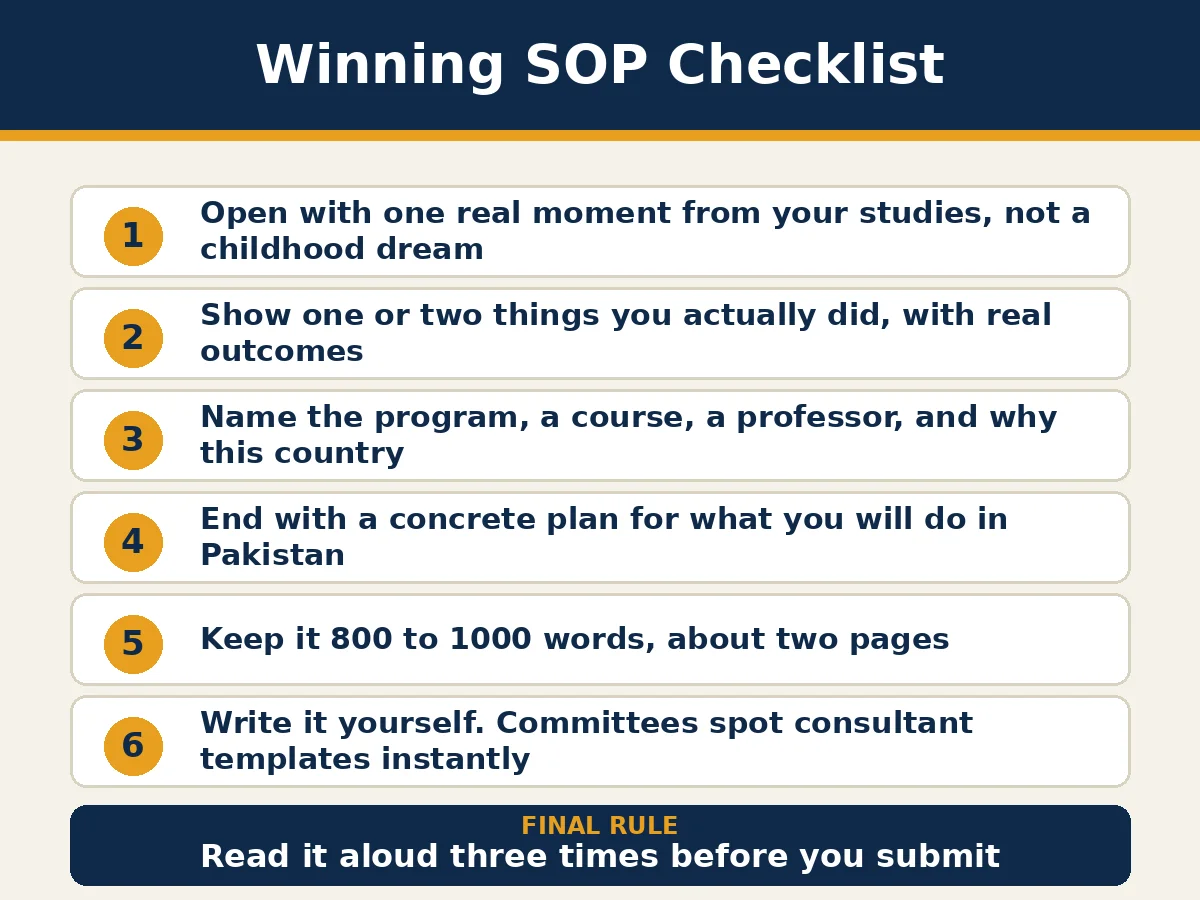
Use these four blocks in this order.
1. The hook: four lines, one real moment
Start with a specific moment from your academic life. Not your childhood. Not a famous quote. A moment.
Weak: "Since my childhood I have dreamed of studying abroad and serving my nation." Strong: "In my third semester at COMSATS Lahore, our database course asked us to design a system for a real client. I built one for a small clinic in my neighborhood, and the doctor still uses it today."
The strong version tells the reader three things in two sentences: what you studied, what you built, and that it mattered to someone.
2. Your academic foundation
This is where most Pakistani students just list their degrees. Do not do that. The committee already has your transcripts. Instead, pick one or two things you actually did and explain what you learned from them.
Weak: "I completed my BS in Computer Science with a CGPA of 3.4 and I am hardworking and dedicated." Strong: "My final year project was a low cost water quality sensor. Testing it in three villages near Kasur taught me that the hardest part of engineering is not the circuit, it is getting people to trust the reading."
Notice that the strong version includes a real opinion. That is what makes it believable.
3. Why this program, why this country
This is the section students copy across applications, and it is the section committees read most carefully. Name the program. Name a course or two. Name a professor or a lab if you can. Explain why Germany, or the UK, or Turkey, and not just anywhere abroad.
Weak: "This prestigious university is world renowned and will help me achieve my dreams." Strong: "The Energy Systems track at TU Delft includes a full module on grid integration of solar, which is exactly the gap in Pakistan's current solar rollout. I cited Professor Van der Berg's 2024 study on net metering in developing grids in my own thesis."
If you cannot write two specific sentences about the program, you have not researched enough to apply yet.
4. Your future plan in Pakistan
Scholarship committees, especially government funded ones, want to know you will return and use the degree. Be concrete. Name an employer, a sector, or a problem.
Weak: "I want to serve my country and contribute to its progress." Strong: "After my degree, I plan to return to the distribution company where I currently work in Lahore and join their planning cell, which is struggling to model rooftop solar load. That is the exact problem I want to spend my career solving."
Mistakes Pakistani students keep making
I review SOPs every admission season, and the same mistakes appear again and again.
Copying consultant templates. Committees read thousands of essays. They know the templates from the big consultancies in Lahore, Karachi, and Islamabad by heart. A copied SOP is an instant rejection.
The childhood dream opening. Unless your childhood genuinely connects to your field, skip it. Nobody believes that a seven year old dreamed of supply chain management.
Borrowed patriotism. Dropping in a quote from Quaid e Azam or Allama Iqbal does not make your essay stronger. It makes it sound like a Pakistan Studies paper.
Writing about the money. Never write that you need the scholarship because your family cannot afford the fees. The committee already knows that. They want to know why you deserve it, not why you need it.
Vague research interests. "I want to research artificial intelligence" tells the reader nothing. "I want to work on Urdu speech recognition for low literacy users" tells them everything.
Listing certificates since matric. Your SOP is not your CV. Do not list every workshop and online course you ever took.
Flowery English. Complicated words do not impress anyone. Clear sentences do. If you would not say it in a conversation, do not write it.
My rule for the final draft
Write the whole thing yourself. Then read it out loud three times. Any sentence that sounds strange when spoken will sound strange when read. Then give it to one honest reader, ideally a teacher who knows your work, and ask them a single question: does this sound like me?
If the answer is yes, submit it. That is what a winning SOP is. Not perfect English. A real person, with a real plan, asking for a real opportunity.
Now put it to work. The scholarships on this site that live or die on essays are Chevening with its four famous essays, Fulbright with its personal statement and study objectives, and Turkiye Burslari where the letter of intent decides everything.
Frequently asked questions
How long should my SOP be?
Aim for 800 to 1,000 words, which fits on about two pages. Committees read thousands of these. A tight two pages will always beat a loose four pages.
Can I use the same SOP for every scholarship?
You can reuse about 70 percent of it, but the section on why this program and why this country must be rewritten for each application. A generic middle section is one of the easiest reasons to reject you.
Should I hire a consultant to write my SOP?
No. Committees can spot consultant templates within seconds, and a polished SOP from a student whose emails are full of errors raises suspicion. Ask a teacher who knows your work to review it instead.