HEC Need-Based Scholarship: Full Tuition Plus Rs 6,000 a Month for Undergraduate Students

The HEC Need-Based Scholarship pays your full university tuition fee plus a stipend of Rs 6,000 per month for your complete undergraduate degree. It is for students in 4-year or 5-year programmes at HEC-selected public sector universities who got admission on open merit and need financial help. The one thing most students get wrong is applying to HEC directly. You never apply to HEC. You apply at your own university's Financial Aid Office.
- Full tuition plus Rs 6,000 a month for the complete programme. For a four-year degree that is Rs 288,000 on top of tuition.
- No national deadline and no online application to HEC. Each university sets its own window, so ask your own Financial Aid Office.
- Open merit admission is a must. Self-finance students, students who already hold another scholarship, and two-year associate degree students cannot apply.
- There is no national income limit. Your university's committee, headed by the Vice Chancellor, judges financial need from your file.
What it pays
The scholarship covers your full tuition fee plus a stipend of Rs 6,000 per month. This support is for the complete programme, not just the first year. The Rs 6,000 figure comes from HEC's own Eligibility Criteria page. Some other websites quote Rs 5,000. That figure is wrong. The correct figure is Rs 6,000. If someone tells you Rs 5,000, show them HEC's own page.
Let me do the math for a four-year programme. Rs 6,000 per month times 48 months equals Rs 288,000. That amount is on top of your tuition fee. So the total value of the scholarship is your full tuition plus Rs 288,000 over four years. For a five-year programme such as Medicine or Pharm-D, the stipend continues for the full five years as well. The tuition is also covered for the complete programme.
The stipend is money for your monthly expenses. It can help with transport, books, food, and other daily costs. The tuition part goes to your university. The stipend reaches you through your university too. HEC does not pay students directly. So your university's financial office handles the payment. If you have a question about a payment, ask your university first.
The full tuition fee means the fee your university charges for your programme. The scholarship covers it for the complete programme. You do not need to pay tuition from your own pocket for the semesters covered by the scholarship.
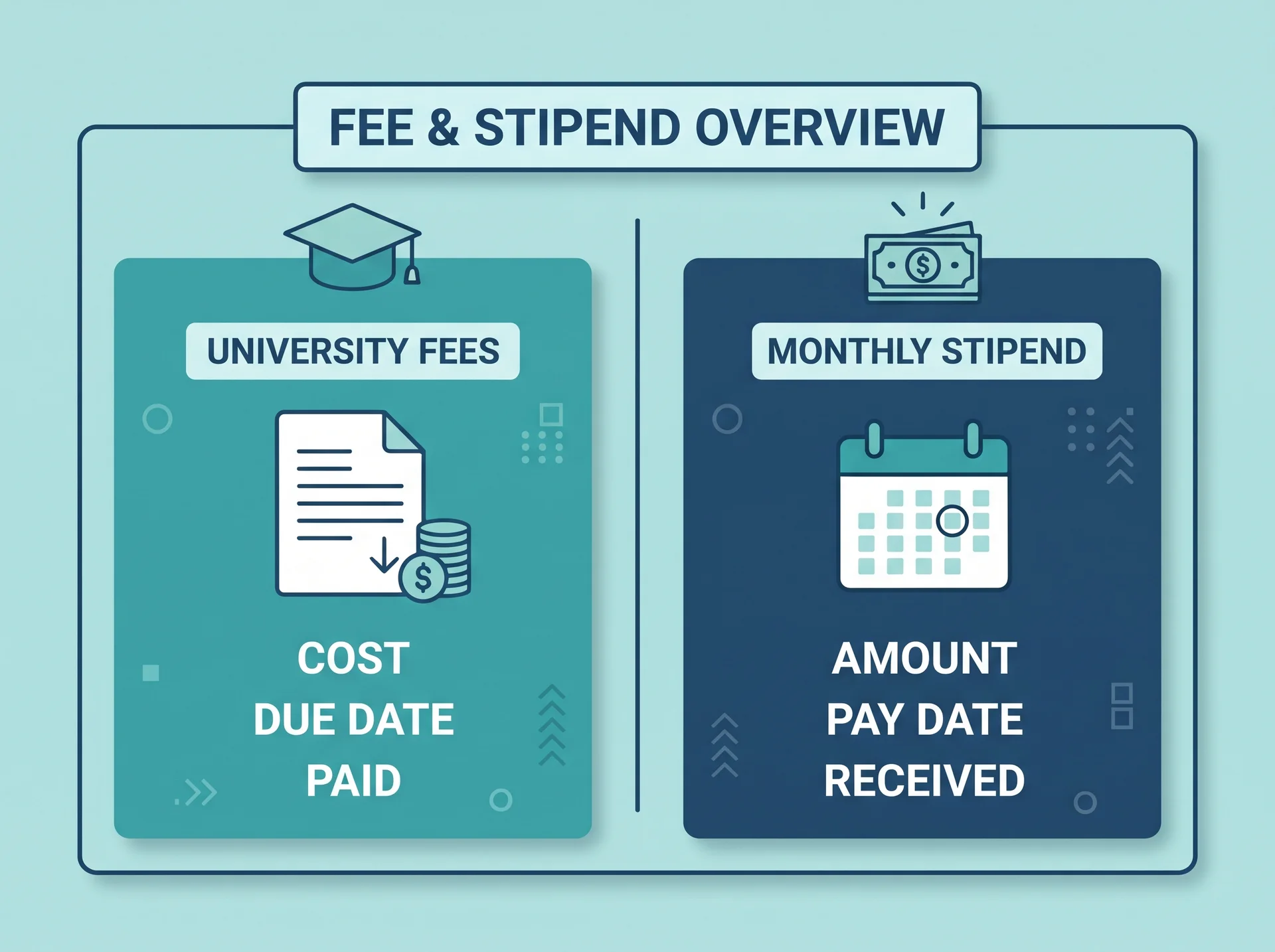
What Rs 6,000 actually covers
Be honest with yourself about this number before you apply, because it decides whether the scholarship solves your problem or only softens it. Rs 6,000 a month will not cover a hostel room and food in Lahore or Islamabad on its own. Think of it as help with transport, books, and daily costs, with the tuition already covered. That is still a large amount of help: over four years it is Rs 288,000 that your family does not have to find.
The practical point is this. If your family can cover your living costs but not the tuition fee, this scholarship closes the gap. If your family cannot cover either, you still need a second plan for living costs, such as staying with family near campus or a part-time campus job, alongside this scholarship. Do not turn the scholarship down because Rs 6,000 sounds small. The tuition part is the big value, and the stipend is real money every month for four or five years.
Who can apply, and who cannot
You can apply if you are an undergraduate student in financial need at an HEC-selected public sector university and you got admission on open merit. You cannot apply if you are on a self-finance seat, already hold another scholarship, or are in a two-year associate degree. Here are the two lists in full.
Who can apply
You are an undergraduate student in a 4-year or 5-year programme. This is the main requirement. Two-year associate degree students are not covered.
Your university is on HEC's list of selected public sector universities and degree-awarding institutions. Not every university is on the list. Ask your Financial Aid Office if you are not sure about your university's status.
Your discipline is included by your university. All disciplines are possible, but each university decides which disciplines to include. So check with your own university. A discipline that is covered at one university may not be covered at another.
You got admission on open merit through your university's own admission policy. This is a must. Open merit means you got the seat on your own marks and the university's normal admission rules. Self-finance seats do not count.
You are already enrolled and now face financial need. This includes students in their third semester. You do not have to be a new student. If your family's situation has changed, you can still apply.
Medicine, Pharm-D and other five-year programmes are funded for the complete programme. So the support does not stop after the first year. It continues for all five years.
Who cannot apply
Students admitted on self-finance seats. HEC states this plainly. Self-finance students are not eligible. No exception is mentioned.
Students who already hold another university or institute scholarship. You cannot hold two scholarships at the same time. If you already have one, you cannot take this one.
Students in two-year associate degree programmes. This scholarship is for 4-year and 5-year programmes only.
Matric students. This is an undergraduate level scholarship only. A Matric student cannot apply. You must be an undergraduate student.
Students at affiliated colleges of participating universities. These colleges are not covered. Only the participating universities and degree-awarding institutions themselves are covered. So check that your college is part of the university and not an affiliated college.
There is no national income limit set by HEC. Whether you qualify as "in financial need" is judged by your university's Institutional Scholarship Award Committee, or ISAC. The committee is headed by the Vice Chancellor. It looks at your family's financial background. So do not search for a fixed income number on HEC's website. There is none. The committee reviews each case on its own. This means two students with different family situations can both qualify.
Financial need means your family cannot easily pay your tuition and living costs. The committee looks at your family's income, assets, and expenses. You do not need to be very poor to qualify. You just need to show that the cost is a real burden for your family.
How to apply, step by step
You apply at your own university's Financial Aid Office, not at HEC. Each university sets its own opening and closing dates. There is no single national deadline and no central application. Follow these eight steps.
-
Confirm your university is on HEC's list of participating public sector institutions. Ask your Financial Aid Office if you are not sure. A quick visit to the office can save you months of confusion. Do this before you do anything else.
-
Get admission on a merit seat. Do not take a self-finance seat. Self-finance students cannot apply. This step is where many students lose their chance before they even start. If you have a choice between a merit seat and a self-finance seat, think about this rule.
-
Collect the application form from your university's Financial Aid Office. You can also download it from HEC's Need-Based Scholarship downloads page. Either way, use the official form only. Do not use a form from a shop or an agent.
-
Fill in all four sections of the form. The sections are personal and family details, family assets, this year's financial arrangements, and education record. Write N/A where something does not apply. Do not leave any section blank. A blank section can make your file look incomplete.
-
Attach the documents from the checklist below. Put them in the order the form lists them. An orderly file is easier for the committee to review. Use a folder or a stapled set so nothing falls out.
-
Submit the form by hand or by post to your university's Financial Aid Office before its deadline. Check your own university's date. HEC does not announce start or closing dates. The 2026-27 round runs university by university, usually weeks or months after admissions close. So the timing depends on your university, not on HEC.
-
Prepare for an interview with the committee. The ISAC committee will review your case. It may ask about your family's financial situation. Answer honestly and keep your documents ready. You can bring copies of your documents to the interview.
-
Wait for the committee's decision. The ISAC committee decides. HEC endorses the final list. The stipend then reaches you through your university. You do not need to contact HEC for the result.
Keep a photocopy of your complete file before you submit it. This helps if you need to check something later or if the office asks for a copy.
Documents checklist
The HEC form asks for five documents. Collect them early. Two of them usually cause delays.
-
Completed application form. Fill all four sections and write N/A where needed. An incomplete form can slow down your case.
-
Copies of your parent's or guardian's CNIC. Make clear copies. Check that the CNIC is valid and not expired. An expired CNIC can delay your file.
-
Salary certificate or salary slip of your parent or guardian. This document usually causes delays. Get it on your employer's letterhead, signed and stamped. Make sure the monthly income figure is clear and easy to read. If your parent is self-employed, ask the Financial Aid Office what to submit instead.
-
Six months of utility bills. This document also causes delays. Collect bills for the last six months, not just the latest one. Keep them in one folder so nothing goes missing. If a bill is missing, ask your utility provider for a duplicate copy.
-
Fee receipts for you and your brothers and sisters. These show what your family already pays for education. Keep copies of all receipts, not just your own.
One line of practical advice for the two problem documents. For the salary certificate, ask your parent's employer well in advance. A stamped letter on letterhead is better than a plain slip. For utility bills, start saving them now. Six months means six months, not two. Keep everything in one folder from day one. Make two sets of copies of every document. Keep one set for yourself. Give the other set with the form.
Documents checklist, printable (PDF)
The five documents above, plus the four form sections, as a one-page printable checklist. Print it and tick each item off as you prepare it.
What happens after you apply
Your university's committee reviews your file, interviews you, and decides. Funding continues for your complete programme, but the scholarship cannot be transferred to another university.
After you submit your form, the Institutional Scholarship Award Committee, or ISAC, reviews it. The committee is headed by the Vice Chancellor. It looks at your family's financial background. You may be called for an interview. Prepare to explain your family's situation honestly. Keep your documents with you at the interview. The committee may ask about your family's assets, income, and expenses.
The number of slots is decided by each university from its own budget. So the number of scholarships can differ from university to university. One university may fund more students than another. This is normal. Funding continues for the complete programme. You do not need to reapply every year for the same degree.
If a student drops out, the slot goes to another candidate on the waiting list for that year. So if you are on the waiting list, stay in touch with your Financial Aid Office. A slot can open at any time during the year. Do not assume the list is final. The waiting list is for that year only. If your name is on the list, you may get a slot if someone drops out. But you should not wait for a slot. Apply for other options too if you need them.
The scholarship cannot be transferred to another university. If you change universities, you lose it. Keep this in mind before you decide to move. The scholarship is tied to the university where you got it. So think carefully before you change universities.
The stipend reaches you through your university. HEC does not pay students directly. If you have questions about the programme, you can call HEC at 051-90808079. For questions about your own file, ask your university's Financial Aid Office.
Key facts at a glance (PDF)
The amount, who qualifies, the deadlines rule, and HEC's contact, on one printable page. Keep it with your application file.
What the interview actually asks
The interview is not a test of your marks. It is a check that the story in your form is real. The committee works from the same four sections you filled in, so the questions follow your own answers. Here is what to be ready for, section by section.
From the family details section, they may ask who earns in your family, what each person earns, and how many people depend on that income. Know the monthly income figure on your salary certificate by heart, and know it the same way your parent stated it. A different number in the interview than on the form looks like a problem even when it is only nerves.
From the assets section, they may ask about the house your family lives in, whether it is owned or rented, and what else the family owns. If you live in a rented house, bring the rent agreement. If the family owns land or a shop, say so plainly. Hiding an asset is worse than owning one, because the committee checks.
From the financial arrangements section, they may ask how you paid last semester's fee and what happens if the scholarship does not come. Have a straight answer. Borrowing from relatives, paying in instalments, or a sister's earnings are all real answers. The committee is judging need, not judging your family.
From the education record, they may ask why your marks dipped in a particular semester, or why you chose this degree. A short, honest answer is enough. Bring your original documents, not just photocopies, and keep a second set of copies in a separate folder in case anything is misplaced on the day.
Three mistakes that end applications
Most failed applications fail for one of three reasons: applying to HEC, applying on a self-finance seat, or submitting an incomplete file or missing the university's deadline. Here is how each mistake works and how to avoid it.
Mistake 1: Applying to HEC directly
Some students search for an HEC application portal and wait for HEC to open applications. This wastes time. There is no online application to HEC for this scholarship. You apply at your own university's Financial Aid Office. Each university sets its own dates. HEC does not announce start or closing dates. If you wait for HEC, you may miss your university's window. So go to your Financial Aid Office early and ask about the form and the dates. Do not wait for a national announcement. There will not be one.
Mistake 2: Applying on a self-finance seat
Some students take a self-finance seat and then apply for the need-based scholarship. This does not work. HEC states plainly that self-finance students are not eligible. You must have secured admission on open merit through the university's own admission policy. If you are on a self-finance seat, talk to your university about your options before you apply. Do not assume the rule will be relaxed. The rule is clear and it is applied.
Mistake 3: Submitting an incomplete file or missing the deadline
Some students submit a form with blank sections, or without the salary certificate, or without six months of utility bills. Others miss their university's own deadline. Both can end your application. Fill all four sections. Write N/A where something does not apply. Attach every document in the order the form lists them. Submit before your university's deadline, not after. Keep a copy of your submitted file for your own record. A complete file on time is your best chance.
Read the form carefully before you fill it. Read the checklist twice. A few minutes of care can save your application.
One more warning. Anyone selling you a form, a guaranteed seat, or an application on your behalf for a fee is running a scam. There is no online application to HEC for this scholarship. Do not pay anyone for a seat. The process is free. You only deal with your own university's Financial Aid Office.
Official links
- HEC Need Based Scholarships, How to Apply
- HEC scholarship portal (overseas schemes)
- HEC Need-Based Scholarship, our BS students guide
Frequently asked questions
What is the HEC Need-Based Scholarship and how much does it pay?
The HEC Need-Based Scholarship is the Higher Education Commission's award for undergraduate students in financial need. It covers the full university tuition fee plus a stipend of Rs 6,000 per month for the complete programme. For a four-year programme, that is Rs 6,000 times 48 months, which equals Rs 288,000 on top of tuition.
Can I apply if I am already in my second or third semester?
Yes. Students who are already enrolled and now face financial need can apply. This includes students in their third semester. You do not have to be a first-semester student. Check with your university's Financial Aid Office for its own window.
Is there an income limit for the HEC Need-Based Scholarship?
No. HEC does not set a national income limit. Whether you qualify as 'in financial need' is judged by your university's Institutional Scholarship Award Committee, or ISAC, headed by the Vice Chancellor. The committee looks at your family's financial background.
Can I apply online to HEC?
No. There is no online application to HEC for this scholarship. You apply at your own university's Financial Aid Office, using the form from the office or from HEC's Need-Based Scholarship downloads page. Anyone offering to submit an application to HEC for a fee is running a scam.
I did not get HEC Need-Based. Can I still study abroad for free?
Yes. These are separate tracks. HEC's overseas schemes, Erasmus Mundus, DAAD and Stipendium Hungaricum do not depend on need-based aid at home. You can apply for them on their own rules. A rejection for the HEC Need-Based Scholarship does not close these doors. Our [fully funded scholarships 2027 guide](/guides/fully-funded-scholarships-pakistani-students-2027/) lists what is open now.