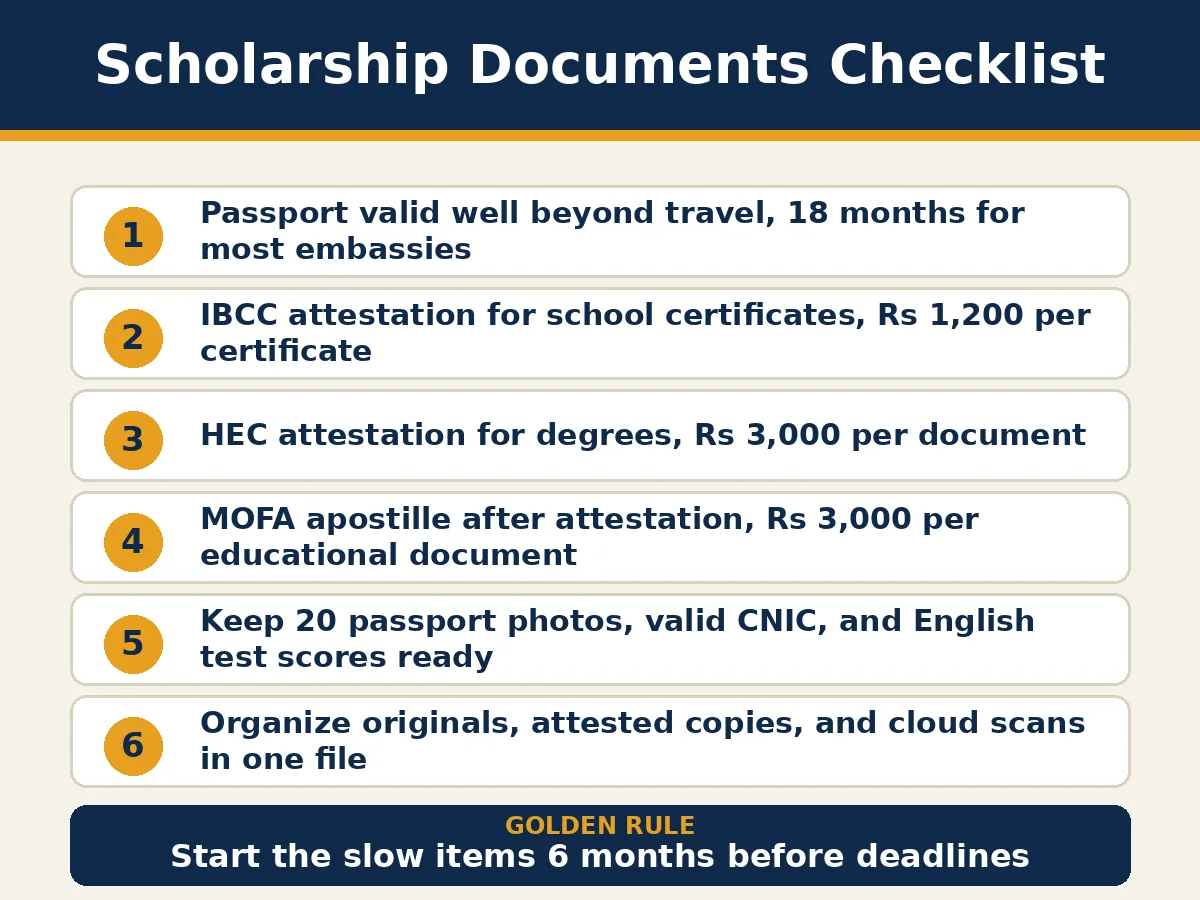
Start with your passport and document attestation, because those take the longest. You will need attested degrees and transcripts, IBCC attested school certificates, MOFA apostille, passport photos, recommendation letters, test scores, and financial proof. Begin at least six months before your first deadline.
- Passport and attestation take the longest, start them six months before deadlines
- School certificates go through IBCC, university degrees go through HEC, then MOFA
- Keep both originals and attested photocopies, plus clear scans of everything
- Check each scholarship's list separately, requirements are never identical
The folder that decides everything
Every admission season, I watch the same tragedy. A brilliant student gets a scholarship interview call, and then loses the opportunity because their passport is expired, their degree is not attested, or their father's name is spelled three different ways across their documents.
Here is my stance: documents are the most boring part of the scholarship process, and the most dangerous. Nobody wins a scholarship because their file was well organized. But plenty of students lose one because it was not. Start this work before you finalize your university list, not after.
Six months before deadlines: the slow items
These take the longest. Start them first.
Passport. Your passport must be valid well beyond your planned travel date. Most embassies want at least eighteen months of validity remaining. If yours is expiring, renew it now through the Directorate General of Immigration and Passports, either online or at your nearest passport office. Ordinary processing takes a few weeks, urgent takes days but costs more. Do not wait until you have an admission letter.
IBCC attestation. Your Matric and Intermediate certificates and result cards must be attested by the Inter Boards Coordination Commission. Your board must verify them first, then IBCC attests. Fee is Rs 1,200 per original certificate. Remove any lamination before submitting, because laminated documents are refused.
HEC attestation. Your university degree, transcript, and provisional certificate go through the Higher Education Commission's online system. Fee is Rs 3,000 per document. The process is fully digital now, but university verification takes ten to fifteen working days, so apply early.
MOFA apostille. After HEC or IBCC, your documents go to the Ministry of Foreign Affairs for the final Pakistani stamp. For countries that accept the Hague Apostille, MOFA issues an apostille at Rs 3,000 per educational document. Online registration on the MOFA portal is required before submission.
Three months before deadlines: the personal items
CNIC or NICOP. Make sure your CNIC is valid and the name spelling matches your passport exactly. If you already live abroad or plan to apply from outside Pakistan, consider getting a NICOP from NADRA.
Passport size photographs. White background, recent, no editing. Keep at least twenty copies. You will need them for test registrations, application portals, and visa forms.
English test score. Book your IELTS, TOEFL, or Duolingo test so that results arrive before your earliest deadline. Remember scores are valid for two years, so do not test too early either.
Recommendation letters. Ask your teachers now. Give them your CV, your SOP draft, and the deadlines. Letters requested at the last minute are always weak.
Statement of purpose and CV. Write these early so your recommenders can read them. Your CV for scholarships should be one to two pages, academic in style, with education first.
Police character certificate. Many visas and some scholarships require one. Get it from your district police office or a Police Khidmat Markaz. It is usually valid for six months, so time it close to your visa application, not a year early.
One month before deadlines: review and extras
Financial proof. Even for fully funded scholarships, visa offices often want proof of funds. This can be bank statements of the last six months, a sponsor affidavit from a parent, or your scholarship award letter. For Germany, you will need a blocked account instead.
Medical certificate. Some countries and scholarships ask for a medical fitness certificate from a designated hospital. Check the requirement early because panel hospitals have waiting times.
Research proposal. For MS research and PhD applications, prepare a two to three page proposal: the problem, why it matters, your proposed method, and expected outcomes. Professors judge this document harshly, so get a teacher to review it.
Portfolio or work samples. For architecture, design, writing, and similar fields, curate your best work. Ten strong pieces beat thirty average ones.
Domicile and other local documents. Some Pakistani scholarships, like HEC need based programs, ask for domicile, income certificates, or utility bills. Keep these ready even for foreign scholarships, because you may apply to local ones as a backup.
How to organize it all
Buy one sturdy file folder and make it your scholarship file. Inside, keep originals in one section and attested photocopies in another. Then scan everything at good quality and keep a digital copy in a cloud folder with clear file names, like "BS_Transcript_HEC_Attested.pdf".
Before every single application, open that scholarship's document list and tick items off one by one. Requirements are never identical. One scholarship wants two recommendation letters, another wants three. One wants the SOP as a PDF, another wants it pasted into a text box with a character limit. The students who get rejected on technicalities are the ones who assumed all lists were the same.
Start the slow items this week. Your future self, holding an interview call with a complete file, will thank you.
Use this checklist against real document lists. Compare it with what Turkiye Burslari asks for, what DAAD EPOS requires in a single merged PDF, and what the Commonwealth Scholarship demands on two separate portals.
Official links
- Directorate General of Immigration and Passports
- IBCC
- HEC online attestation portal
- Ministry of Foreign Affairs
- NADRA
Frequently asked questions
Do I need my documents translated into English?
If any document is in Urdu, such as an older domicile or a Nikah Nama, get it translated by a certified translator and keep both versions. Degrees and transcripts from Pakistani universities are already in English and do not need translation.
How many passport photos should I keep ready?
Keep at least twenty recent passport size photos with a white background. You will need them for the passport office, test registrations, visa forms, and university applications. Getting them done once in bulk is cheaper.
What if my name is spelled differently on different documents?
Fix this before you apply. Get the spelling unified according to your CNIC and passport, because mismatched names are one of the most common reasons documents get rejected at attestation offices and embassies.