Commonwealth Scholarship 2027: Fully Funded Masters and PhD in the UK for Pakistanis
The Commonwealth Scholarship funds a full time Masters or PhD in the UK for Pakistani students, covering tuition, return airfare and a monthly stipend of 1,712 pounds outside London or 2,000 pounds in London. The 2027 to 2028 round closed on 20 October 2026 on both the Commonwealth portal and the HEC portal. HEC nominates candidates strictly on the HAT test, with a minimum score of 60 out of 100, and HEC held 26 nominations for Masters and 30 for PhD in this round. The next round dates are not announced yet.
- The 2027 to 2028 round closed on 20 October 2026 on both portals. Nominations are expected in December 2026 and results in July 2027
- You need a HAT score of at least 60 out of 100 in categories one to four. HEC ranks nominees on this score alone
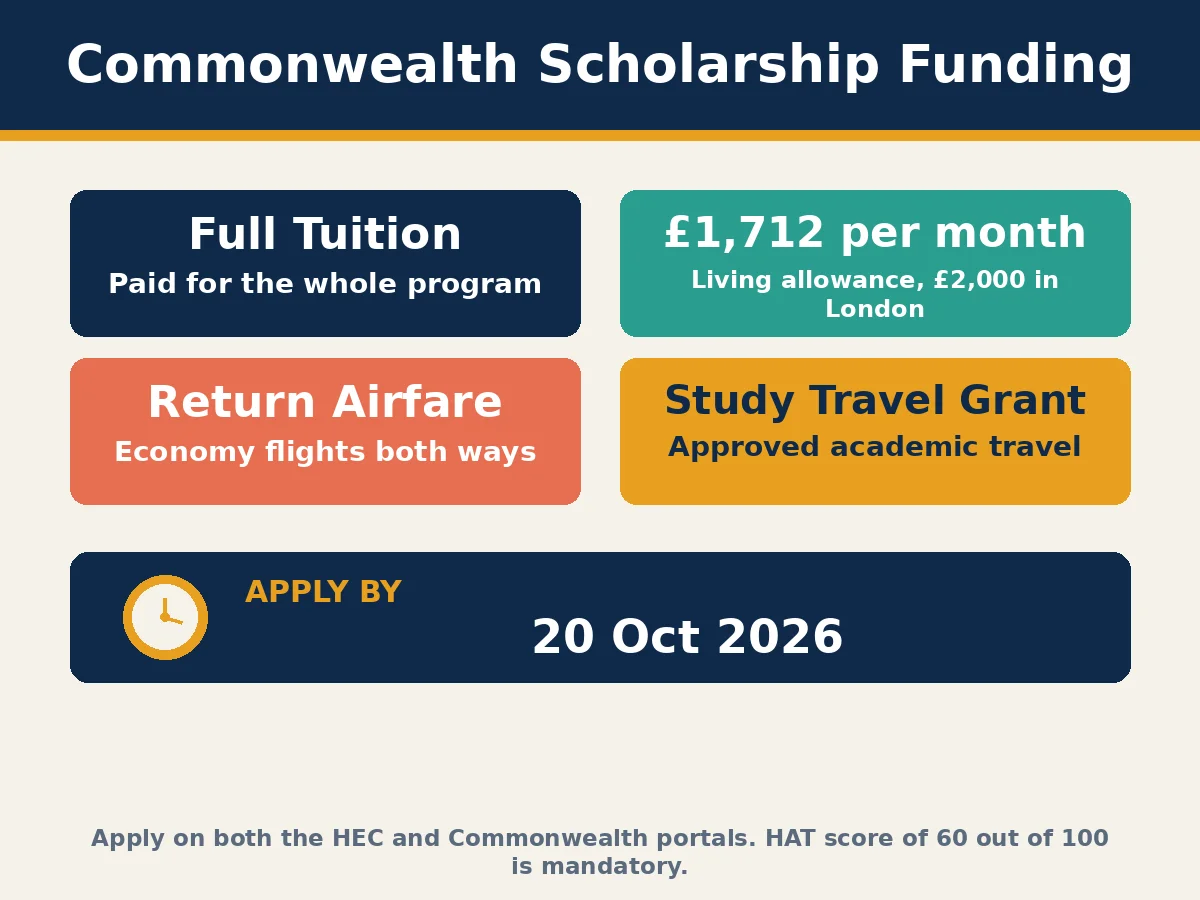
- Covers full tuition, return airfare and 1,712 pounds a month outside London, or 2,000 pounds in London
Two doors, one test
The Commonwealth Scholarship is the UK government paying for your full postgraduate degree because you come from a Commonwealth country and you cannot afford it yourself. For Pakistanis it is run through two doors at once. The Commonwealth Scholarship Commission in London runs the award. HEC in Pakistan picks who gets nominated. Miss either door and you are out.
And there is one test that decides the Pakistani door. HEC ranks its nominees strictly on the HAT test score, with a minimum of 60 out of 100. That single number matters more at the nomination stage than your degree, your essays and your dreams combined. This page explains the whole scheme, but if you remember one thing, remember the HAT.
Official information checked 13 November 2026. The deadline, the stipend rates and the HAT rules below are from the Commonwealth Scholarship Commission site and the HEC announcement for the 2027 to 2028 round.
What changed for the 2027 to 2028 round
The round for study starting in September or October 2027 is closed. Here is where it stands.
| Stage | Date |
|---|---|
| Applications closed on both portals | 20 October 2026. HEC portal closed at 4:00 pm Pakistan time, Commonwealth portal at 4:00 pm UK time |
| HEC nominations expected | December 2026 |
| Results expected | July 2027 |
| Studies begin | September or October 2027 |
| Next round | Dates not announced yet |
HEC held 26 nominations for Masters and 30 nominations for General PhD in this round. Those are nomination slots, not final awards. The Commission chooses the scholars from the nominations it receives, and a nomination is no guarantee of selection. If you applied in this round, watch your email, including the junk folder, because the Commission contacts all applicants by email and a scholarship offer can be withdrawn if you do not reply in time. If you missed this round, the next one has no announced dates yet, so this is the time to sit the HAT test and build your file.
The HAT test, explained properly
This is the section most guides rush through, and it is the section that decides Pakistani nominations.
The rule. Every applicant must provide a HAT test score. You need at least 60 out of 100. Only HAT categories one, two, three and four are accepted. HAT tests taken for admission to Pakistani national universities do not count for this scholarship.
Which scores count. HEC accepts scores from HAT tests taken on or after 25 October 2024. The test scheduled for 25 October 2026 was the last test eligible for this nomination round, according to the HEC announcement. If your result came after the 20 October deadline, you did not need to add marks by hand. HEC takes the score from its own records.
How merit is decided. Merit is determined strictly on the basis of HAT score, subject to any change in the merit criteria HEC prescribes. The last completed degree percentage is used when scores are tied. That is the whole ranking system at the HEC stage. Your essays only matter once you reach the Commission stage in London.
What to do about it. If your HAT is below 60, do not spend October writing essays. Book the next HAT sitting and aim for 80 or above, then come back next cycle. If your HAT is strong, your essays still decide whether London picks you, so write them like someone who has actually read about Pakistan's problems rather than copying generic development language from the internet.
What the award pays
This is a genuine full package, not a partial discount dressed up as a scholarship.
| Benefit | Amount |
|---|---|
| Tuition fees | Paid in full by agreement between the Commission and your UK university |
| Return airfare | Approved economy airfare from Pakistan to the UK and back at the end of the award |
| Monthly stipend outside London | 1,712 pounds a month |
| Monthly stipend in the London area | 2,000 pounds a month |
| Study travel grant | Towards the cost of study related travel within the UK or overseas |
| Warm clothing allowance | Paid to scholars arriving from warmer climates |
| Child allowance | 622 pounds a month for the first child, and 154 pounds a month for the second and third child under 16, if you are widowed, divorced or a single parent and your children live with you in the UK |
| For PhD scholars | Extra help for approved fieldwork and a mid term visit back home |
The stipend rates above are the current rates published by the Commission for this cycle. The Commission reviews them every year, so the next round may pay a different figure. The child allowance is only a contribution towards the cost of maintaining a family in the UK. The true costs are likely to be considerably higher, and the Commission says plainly that scholars must be able to supplement these allowances to support any family members who accompany them.
The four part development impact statement
Once you pass the HEC stage, the Commission judges you on development impact. The application form asks for a development impact statement in four parts, and each part has a job to do.
- The problem. Explain how your proposed scholarship relates to development issues at the global, national and local level, and to the development issues connected to your chosen CSC theme and the wider sector. Name real problems in real places, with real numbers if you can find them.
- What you will do with it. Explain how you intend to apply your new skills once the scholarship ends. This is about your return to Pakistan, not about staying in the UK. Every scholar signs an undertaking to return home before their student visa expires.
- What will change. Outline what you expect will change in development terms after the scholarship, including the outcomes you aim to achieve, the timeframe for them, and who the beneficiaries will be.
- How it will be measured. Write about how the impact of your work could best be measured and evidenced. Vague promises score badly here. A plan that names a measurable result scores well.
The form also asks for a personal statement about how your background encouraged you to want to make an impact in your home country, a summary of your voluntary activities and leadership, your employment history, and your career plans for the five years after the scholarship plus your long term plans. Write all of it in your own words. The Commission reads thousands of these, and copied development language is easy to spot.
Who can apply, and who should skip this one
Read this list honestly before you spend a week on the application.
You are eligible if you:
- Are a Pakistani or AJK national and a permanent resident of Pakistan or AJK. HEC says dual nationals are not eligible.
- Hold a first degree at upper second class level or above, meaning roughly 60 percent or above in the Pakistani system, or a lower second class degree plus a relevant postgraduate qualification, usually a Masters
- Score at least 60 out of 100 in the HAT test, in categories one to four
- Can show that you cannot afford UK study without this scholarship
- Are available to start academic studies in the UK by the start of the UK academic year in September 2027, and hold your first degree by then. Final year students can apply as long as the degree is complete before the start.
Who should NOT apply:
- Anyone planning an MBA. It is explicitly excluded, and research based Masters degrees are excluded too.
- Anyone who already holds a UK degree at the same level you are applying for, or who already received a Commonwealth Scholarship at Masters level. The Commission would not normally fund a second Masters, and anyone applying for one must justify why they need it.
- Anyone who cannot get a HAT score of 60. Without it your essays will never be read.
- Anyone who is already registered for a PhD, or an MPhil leading to a PhD, before September or October 2026. The PhD route is for new doctoral students, and the PhD award runs for 36 months.
- Anyone who wants a degree for emigration purposes only. The whole scheme is built around development impact back home, and the application asks you to prove it.
- Anyone who is an employee, a former employee or a relative of an employee of the UK government, the Association of Commonwealth Universities, the British Council, or a Commonwealth Scholarship Commissioner. Former employees become eligible three years after leaving.
There is no age limit for Commonwealth applications. The Commission says so plainly. If you are older, check with your employer about leave, not with the Commission about age.
Your documents checklist
Print it first: Commonwealth Scholarship documents checklist (PDF). One page, tick boxes, the same list as below, plus the two portal links and the last confirmed dates.
Tick each item off as you prepare it:
Two warnings from the Commission itself. If any transcript is missing pages, your application will be considered ineligible. And the Commission will not accept supporting documents submitted outside the online application system, so do not email documents to London and hope for the best.
How to apply, step by step
- Shortlist eligible UK courses and list three universities and courses in order of preference, with your reasons. The Commission will not change your university or course after selection, so include a second and third choice. If you list only one and the Commission cannot place you there, the scholarship cannot proceed.
- Apply for admission to your preferred universities in advance. Many courses have strict admission deadlines, and if you are selected but have not applied and been accepted, it may not be possible to proceed.
- Register on the HEC scholarship portal and on the Commonwealth online application system.
- Take or confirm your HAT score. Without 60 or above, stop here.
- Draft your study plan and development impact answers. Keep them specific to Pakistan, with real numbers and real places if you can.
- Request your references early and confirm they were uploaded. Referees must upload them in PDF format by the deadline, and the Commission cannot accept them any other way or after that date.
- Submit both applications before the deadline, and save and screenshot every confirmation page. HEC will not reopen the portal for you.
If you are applying from Pakistan
This section is for Pakistani applicants only. The rest of the guide applies to everyone, from any country.
- HEC is your nominator, not London. You apply to HEC and to the Commission, and HEC ranks you on your HAT score. A nomination from HEC does not guarantee a scholarship, because the Commission makes the final selection.
- Get your HAT score early. The test on 25 October 2026 was the last one eligible for this round, so if you missed it, your next chance is the next cycle. Keep your score slip safe, and check the HEC announcement for the next round before you book a new test.
- Attestation takes time. Get your HEC attested degree sorted months before the deadline. Attestation queues in Pakistan get long near October, and a missing transcript page makes your whole application ineligible.
- Pick your three universities with care. The Commission funds study only at approved UK universities with a part funding agreement for your programme, and it considers value for money when it places you. A course that fits the six CSC development themes and a real Pakistani problem will serve you better than a famous name with no link to your plan.
- Write your own essays. Ask a teacher or a friend to read them, but do not copy development language from the internet. The Commission reads thousands of applications, and the ones that name a real district, a real hospital or a real school stand out.
If the HAT route does not work for you, the UK has other doors. Chevening funds a one year masters with no test score at all, and Gates Cambridge is the top tier option if your grades are exceptional.
Official links
- Commonwealth Masters Scholarships page
- Commonwealth PhD Scholarships page
- HEC Commonwealth Scholarship announcement 2027 to 2028
- Commonwealth online application system
- HEC scholarship portal
Frequently asked questions
Is the Commonwealth Scholarship open right now?
No. The 2027 to 2028 round closed on 20 October 2026 on both the Commonwealth portal and the HEC portal. HEC is expected to nominate its candidates in December 2026, and the Commission is expected to announce results in July 2027. The next round dates are not announced yet, so the right move now is to sit the HAT test and prepare your documents for the next cycle.
Do I need IELTS for the Commonwealth Scholarship?
The Commonwealth Scholarship Commission does not require any candidate to take an IELTS test. Your UK university may still ask for proof of English for admission, so check the language rules of each course you list. The scholarship itself does not set an English test rule.
Can I apply for an MBA on the Commonwealth Scholarship?
No. The Commission funds one year taught Masters programmes only and does not fund MBA degrees or research based Masters degrees. It funds taught Masters and full PhD programmes, and applicants for a second Masters must justify why they need another one.
What if my HAT score is below 60?
Then HEC cannot nominate you in this scheme. HEC requires at least 60 out of 100 in HAT categories one, two, three or four, and ranks nominees strictly on this score. Book the next eligible HAT sitting, aim for 80 or above, and come back next cycle rather than spending weeks on essays that will never be read.
Does a HEC nomination mean I have won the scholarship?
No. HEC held 26 nominations for Masters and 30 for PhD in the 2027 to 2028 round, and nomination only puts you in the pool the Commission chooses from. The Commission makes the final selection, and a nomination is no guarantee of a scholarship. That is why your development impact statement and your three university choices still matter.