Australia Awards Pakistan: The Scholarship Built for Working Professionals
Australia Awards is the Australian government scholarship for Pakistani citizens with 16 years of education and five years of relevant work experience. It funds a full masters degree in Australia: tuition, return airfare, a fortnightly living contribution, health cover and academic support. The 2027 intake closed on 30 April 2026. The official site says applications will reopen in early 2027, and the pattern from past years points to a 1 February to 30 April 2027 window for study starting in 2028.
- 2027 intake is closed. Applications reopen in early 2027, expected 1 February to 30 April 2027 for study starting in 2028.
- For Pakistani professionals only: 16 years of education plus five years of relevant work experience in Pakistan, age under 45.
- Fully funded masters in Australia with a two year return commitment to Pakistan, and a Development Impact and Linkages Plan that decides most selections.
Who this scholarship is really for
Picture a civil engineer in Lahore with seven years on water projects, or a doctor in Peshawar who has run a district health programme for six years. Both have a degree, a career and a clear idea of what is broken in their field. Australia Awards is built for them. It is not a student scholarship. It is a leadership investment by the Australian government, run by the Department of Foreign Affairs and Trade, and it pays for a full masters degree in Australia for Pakistani professionals who will go home and change something: a policy, a hospital, a power grid.
That single fact decides almost everything about the application. Fresh graduates cannot apply, however strong their grades. The panel does not ask how clever you are. It asks what you have done in five years of work, what you will study, and what Pakistan gets when you return.
What the money covers, in plain numbers
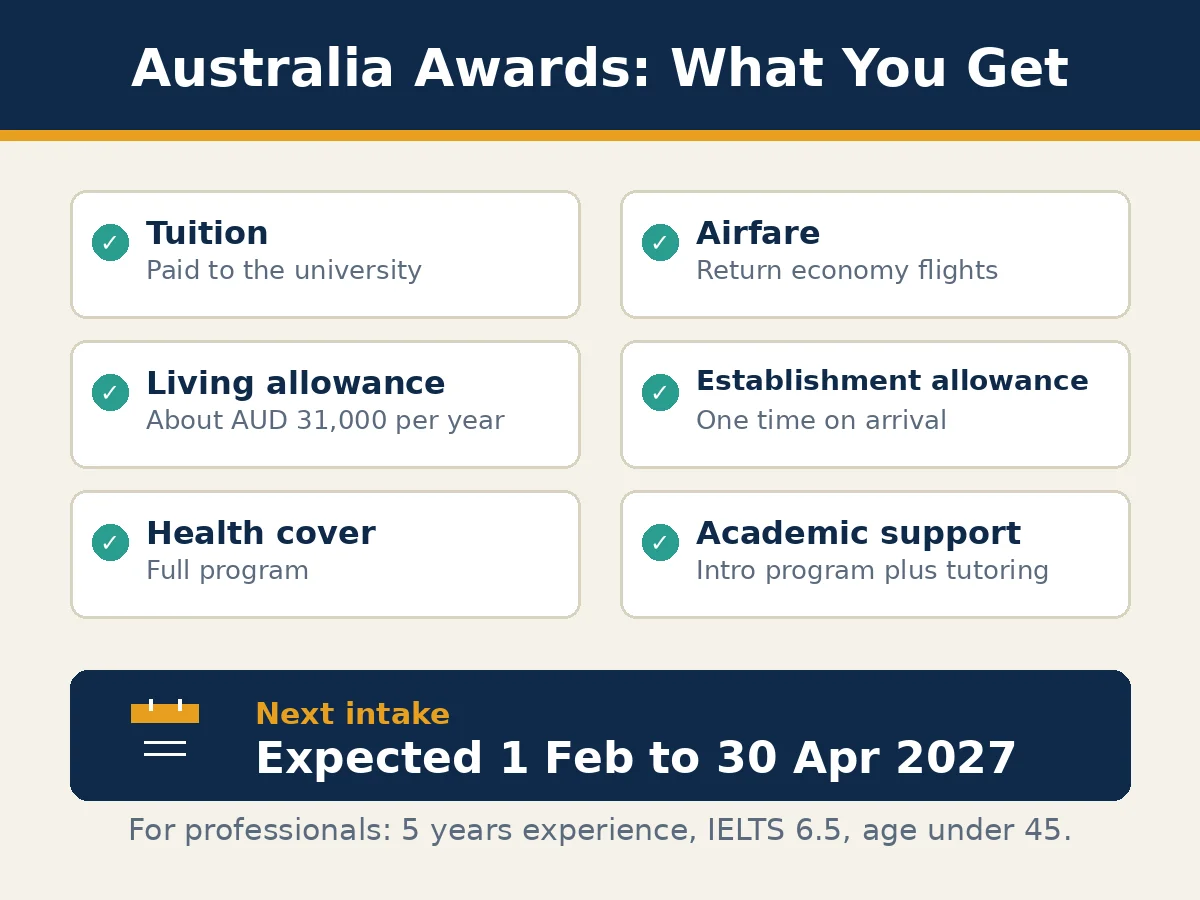
| Benefit | Details |
|---|---|
| Tuition | Full tuition paid directly to the Australian university |
| Airfare | Return economy flights between Pakistan and Australia |
| Living contribution | Fortnightly contribution to living expenses, paid into your Australian bank account. Under the June 2026 Policy Handbook it was A$99.26 a day, about A$36,230 a year, and it is currently tax exempt. DFAT indexes the rate, so confirm the current figure before you budget |
| Establishment allowance | One off payment of A$5,000 on arrival, for a rental bond, textbooks, study materials and setting up a home |
| Health cover | Overseas Student Health Cover for the full program |
| Academic support | Introductory Academic Program of four to six weeks, plus tutoring if you need it |
| Research travel | Support for approved fieldwork related to your study, where the program allows it |
Two honest notes. First, the living contribution is a contribution, not a salary. It covers rent, food, transport and daily costs in most Australian cities, but Sydney and Melbourne rents stretch it hard, so scholars in those cities usually share housing. Second, dependants are not covered.
The 2028 calendar, as it stands today
| Stage | Date |
|---|---|
| 2027 intake applications | 1 February to 30 April 2026, now closed |
| Next intake opens | Early 2027, exact date not announced yet |
| Expected window | 1 February to 30 April 2027, following the pattern of past years |
| Study starts | 2028, for the intake that opens in early 2027 |
The official Australia Awards Pakistan site says applications will reopen in early 2027. The February to April window is the pattern from every recent intake, not a confirmed date for the next round. Treat 1 February 2027 as the date to be ready by, not the date to start preparing. The work that wins this scholarship, the English test, the documents, the Development Impact and Linkages Plan, takes months. Start it now, while the portal is closed.
Official information checked 12 November 2026. The 2028 intake dates are not announced yet, so the February to April window is the pattern from the 2027 intake, not a confirmed date. Confirm on australiaawardspakistan.org before you plan around it.
Five gates, and how to clear each one
Every applicant must pass all five. There is no partial credit and no waiver for four out of five.
1. Pakistani citizen, living in Pakistan. You must be a Pakistani citizen residing in Pakistan and applying from Pakistan, and you must have lived in Pakistan for at least 24 months before applying. You cannot apply from abroad, and you cannot hold Australian citizenship or permanent residency.
2. Sixteen years of education. You need a bachelors degree that adds up to 16 years of formal education. A four year bachelors qualifies directly. A two year BA or BSc plus a two year masters also reaches 16 years. Check your own total before anything else, because this gate ends more applications than any other after work experience.
3. Five years of relevant work experience in Pakistan. The work must be relevant to the field you want to study, and it must be real professional work. Internships, volunteer work and part time student jobs do not count. Your CV and your referee reports must show the five years clearly, with dates, employers and duties.
4. Age under 45. You must not be more than 45 years of age at the time of application. Count your age on the closing date, not the opening date, and do not leave this to the last week if your birthday falls near the deadline.
5. English at the required level. You need Academic IELTS 6.5 overall with no band below 6.0 at the time of application, at your own expense. TOEFL and PTE equivalents are also accepted: PTE Academic 58 overall with no communicative skill below 50, and TOEFL 84 overall with at least 21 in each subtest. Book the test early. Test centres in Pakistan fill up before scholarship deadlines, and a late result means a missed intake.
One more rule that surprises people: you cannot already hold a masters degree and apply for another masters at the same level. Australia Awards Pakistan funds masters study only, and only for applicants who do not already hold an equivalent qualification.
Fields Pakistan needs most
Australia Awards Pakistan does not fund any subject. It funds fields that serve Pakistan's development priorities, agreed with the Government of Pakistan. For the 2027 intake the priority areas were climate change adaptation and mitigation, empowerment of women and girls, agriculture and food security, water security and resource management, infrastructure planning and delivery, inclusive economic growth, public policy and governance, public health, renewable energy and education. Related disciplines such as disaster risk reduction, environmental management, gender studies, food security and peacebuilding also fit.
Your proposed course must sit clearly inside one of these areas. A general MBA with no development link is a weak fit. A masters in water resource management for an engineer who has spent five years on irrigation projects is a strong fit. When you choose between two courses, pick the one whose department works on exactly the problem your plan describes.
The DILP, and how a strong one reads
The Development Impact and Linkages Plan is the heart of the application, and it is where strong profiles most often fail. It is a document on the official template where you explain how your chosen field of study will help Pakistan develop, with clear objectives for what you will do after returning. A vague plan is the most common reason strong profiles get rejected.
A winning plan has four parts, and each part names something specific.
The problem, with evidence from your own work. Name one problem you have seen at close range. A water engineer might write about water losses in her city's supply network, with the figures she has measured herself. General statements about poverty or climate change, with no numbers and no personal observation, read as copied.
The gap in your knowledge. Explain what the Australian degree adds that you cannot get locally. A specific course, a lab, a research group, a policy method. If you could learn the same thing in Lahore, the panel wonders why Australia should pay for the trip.
The return plan, in years. Lay out what you will do in year one, year two and year five after returning. Year one might be a pilot in your own department. Year two might be a scale up across a district. Year five might be a policy proposal or a training programme for others. Dates and places beat adjectives.
The linkages. Show who you will work with on return: your employer, a government department, a university, a professional body. Named partners with real roles make the plan credible.
Give this document weeks, not days. Write it, leave it, rewrite it. Ask a colleague who knows your field to read it and mark every sentence that could belong to anyone else. Those sentences are the ones to fix.
Your documents, and what goes wrong with each one
Upload everything to OASIS, the online application system, as color scans in single PDFs by category. Use your full legal name exactly as printed on your passport, everywhere, on every document.
| Document | What counts | What goes wrong |
|---|---|---|
| Degree certificates and transcripts | Both sides, clearly scanned, with HEC attestation where the profile asks for it | Blurry phone photos, missing back pages, name spelled differently from the passport |
| Updated CV | Focused on professional and development work, with dates and duties | A generic CV that lists degrees first and hides the five years of work |
| English test result | IELTS, TOEFL or PTE at the required scores, valid at application | Booking the test too late, or one band below the minimum |
| Referee reports | Academic and employment referees on the official forms, from people who know your work | A famous name who barely knows you, or a referee who misses the deadline |
| Development Impact and Linkages Plan | On the official template, specific and tied to your work | A personal essay about your dreams, with no problem, no plan and no dates |
| No Objection Certificate | Required if you are a government employee. Start this early | Leaving the NOC until the last week. Government NOCs move slowly and nobody at Australia Awards can speed yours up |
| Passport copy | Valid passport, full legal name used exactly as printed | A nickname or a shortened name that does not match your degrees |
Download the checklist: Australia Awards Pakistan documents checklist (PDF). One page, tick boxes, everything in the table above. Print it and tick each item off as you prepare it, and keep it with your application file.
If you are applying from Pakistan
This section is for Pakistani applicants only. The rest of the guide applies to everyone the programme covers, but these points come from how the process actually works in Pakistan.
Start the NOC now if you work for government. Federal and provincial employees need a No Objection Certificate from their department, and the file moves through more than one office. Scholars have missed intakes waiting on an NOC. Ask your department what it needs, file it months before the portal opens, and follow up in person.
Match your name everywhere. Your passport, your degrees, your CNIC and your OASIS profile must carry the same full legal name in the same spelling. If your degree spells your name differently from your passport, sort that out with your university and HEC before you apply. A mismatch can stall verification for weeks.
Book IELTS early, in your own city. Test seats in Lahore, Karachi and Islamabad fill up in the months before the April deadline. Book while the portal is still closed, so a full centre never decides your intake for you.
Get HEC attestation sorted before the rush. Australian universities ask for attested documents at enrolment, and HEC attestation queues are slow. Our HEC and IBCC attestation guide covers the process step by step.
After you submit: interview, visa and arrival
Shortlisted candidates are invited to an interview. It tests your leadership and the credibility of your return plan, and the panel will press you on your DILP. Expect questions like why this course, why Australia, and what exactly you will do in your first year back.
If you are selected, you sign a contract that includes the two year return obligation. Scholars who do not return to Pakistan for at least two years after finishing breach their contract and can be asked to repay the scholarship. Treat this as a condition, not a suggestion, and discuss it with your family before you accept.
Before departure you complete the Introductory Academic Program, four to six weeks of academic preparation in Australia that covers study skills, academic writing and settling in. Your institution arranges initial accommodation unless you tell it in writing that you do not need it.
Five mistakes that end applications
- Applying as a fresh graduate. The five years of work experience is a hard rule, not a preference. If you do not have it yet, spend the waiting year building relevant experience and apply next time.
- A DILP that could belong to anyone. If your plan names no specific problem, no place and no dates, the panel cannot tell you apart from a hundred other applicants.
- Choosing a famous university over the right course. A lesser known university with a department doing exactly what your plan needs beats a famous name with a loose connection to your field.
- Submitting late. Late applications are not considered, no exceptions. OASIS closes at the published time, and the clock is Australian Eastern Standard Time, not Pakistan time. Submit days early.
Official links
- Australia Awards Pakistan
- OASIS online application system
- Australia Awards Scholarships Policy Handbook
Frequently asked questions
I hold a two year BA or BSc. Can I apply?
Not on that degree alone. Pakistan requires 16 years of education in total, so a two year BA or BSc falls short by itself. The same degree plus a two year masters brings you to 16 years and meets the rule, as long as your work experience and English scores also qualify.
Does my five years of work experience have to be in Pakistan?
Yes. The Pakistan country profile requires five years of relevant work experience in Pakistan. Experience abroad does not replace it, and internships and volunteer work do not count toward the five years.
I am over 45. Is there any exception?
No. You must not be more than 45 years of age at the time of application, and no exception to that rule is published for Pakistan. If you are close to the limit, apply in the next window rather than waiting a year.
Can my family come with me to Australia?
Australia Awards does not fund dependants. If your family travels with you, you cover their living costs and visas yourself, and you should budget for that honestly before you accept. Many scholars go alone for the study period and return home between semesters.
My IELTS is 6.5 overall but one band is 5.5. Does that pass?
No. Pakistan requires IELTS Academic 6.5 overall with no band below 6.0, so a single weak band fails the rule even when the overall score is fine. Retake the test and fix the weak band. Applicants with disability may apply with IELTS 6.0 and no band below 5.0, and if selected they must reach the required score before starting the scholarship.