Attest school certificates through IBCC at Rs 1,200 per original, then university degrees through HEC's online system at Rs 3,000 per document, then get the MOFA apostille at Rs 3,000 per educational document. Start at least six weeks before you need the documents, and never pay an agent to do this for you.
- IBCC handles Matric and Intermediate, HEC handles university degrees, MOFA comes last
- Your board must verify school certificates before IBCC will touch them
- HEC attestation is fully online now with a digital certificate, no office visit needed
- Budget around Rs 20,000 for a full set and start six weeks before deadlines
Why attestation comes before everything else
Of all the steps in a scholarship application, attestation is the one students underestimate most. It looks like a formality. It is actually a chain of three separate government processes, each with its own portal, fee, and waiting time, and each depending on the one before it.
My stance is blunt: never pay an agent for attestation. Every step described below can be done online or with one office visit, and agents charge five times the official fee for work you can do yourself in an afternoon. The system was redesigned to cut out middlemen. Use it as intended.
The chain in one picture
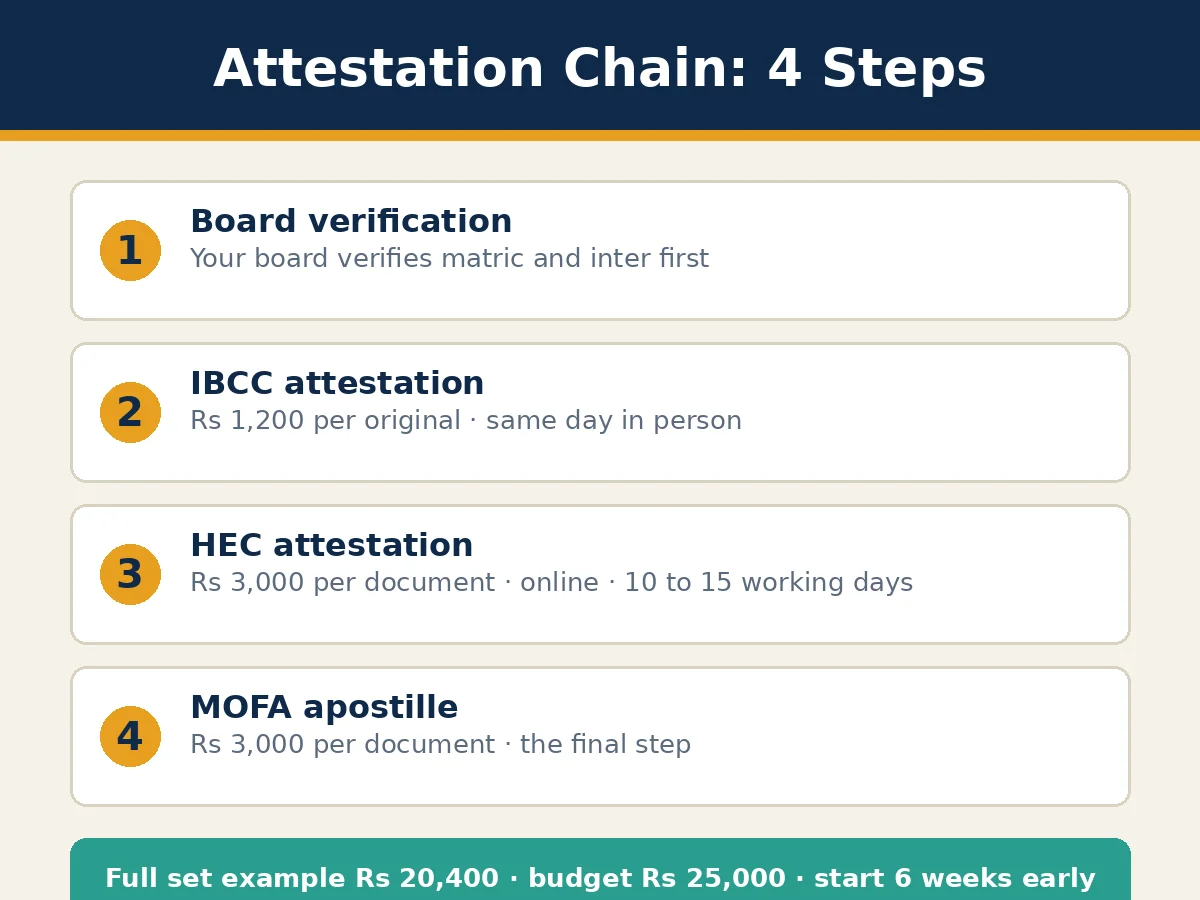
For school certificates: your board verifies, then IBCC attests, then MOFA attests. For university degrees: HEC verifies and attests, then MOFA attests.
Get the order wrong and you will be sent back to the start. Now the details.
Step 1: IBCC attestation for Matric and Intermediate
The Inter Boards Coordination Commission handles everything up to Intermediate level: Matric certificates, Intermediate certificates, result cards, and diplomas like DAE.
First, board verification. Before IBCC touches your documents, your own board, for example BISE Lahore or the Federal Board, must verify them. This is the step students miss. You cannot skip your board and go straight to IBCC.
Then apply on the IBCC portal. Register at the IBCC attestation portal, fill in your details, upload scans, and book an appointment at the nearest IBCC office. IBCC has offices in Islamabad, Karachi, Lahore, Peshawar, Quetta, and Bahawalpur. There is also a courier option through TCS if you cannot visit in person.
Fee and time. The fee is Rs 1,200 per original certificate. Walk in appointments are usually processed the same day if your documents are complete. The courier route takes seven to ten working days.
Two warnings. First, remove any lamination from your certificates before submitting. IBCC refuses laminated documents, and peeling lamination off at home often destroys the certificate. Second, your name, your father's name, and your date of birth must match your CNIC exactly. Even a small mismatch gets the file marked deficient.
Step 2: HEC attestation for university degrees
The Higher Education Commission handles Bachelor's, Master's, and higher degrees, plus transcripts and provisional certificates. In May 2026, HEC moved to a fully online digital system, so the old days of standing in line at the HEC office are over.
Create your account. Register on the HEC e services portal with your CNIC, email, and mobile number. Fill in your complete academic record from Matric onward. The system requires the full chain with no gaps. If you skip your Intermediate details, the application gets flagged.
Upload and pay. Upload clear scans of your CNIC, degree, transcript, and any other document you want attested. Select the documents, and the portal calculates the fee: Rs 3,000 per document. Payment is online through the banking system. The fee is non refundable, so double check your selections before paying.
Wait for verification. HEC sends your record to your university for verification. This takes five to eight working days if your university responds promptly, longer if it does not. Then HEC does its final review, which takes another three to five working days. Expect ten to fifteen working days in total.
Download your certificate. Instead of a physical stamp, HEC now issues a digital e Attestation Certificate secured on blockchain. Any university or embassy in the world can verify it online instantly. Save it, print it, and keep it with your documents.
Special cases. Medical graduates may need their PMDC registration. MS and MPhil degrees from programs launched after 2013 may need an HEC no objection certificate. A and O Level students need an IBCC equivalence certificate before HEC will process their file. Check these before you apply, not after a rejection.
Step 3: MOFA attestation or apostille
The Ministry of Foreign Affairs is the final Pakistani stamp. For most study destinations in 2026, you want the apostille, which Pakistan issues as a member of the Hague Apostille Convention. An apostille is accepted directly by the destination country with no embassy legalization step needed.
Register online first. Since July 2026, MOFA does not accept apostille applications without prior online registration on its apostille portal. Do not walk in without registering.
Submit and pay. Submit your HEC or IBCC attested originals at a MOFA office in Islamabad, Lahore, Karachi, Peshawar, or Quetta, or through one of the authorized courier companies. The fee for an educational document apostille is Rs 3,000 per document. Processing usually takes a few working days.
What a full set costs: a real example
Take a typical BS graduate applying for a masters abroad. Two school certificates through IBCC: Rs 2,400. Degree plus transcript through HEC: Rs 6,000. Four documents through MOFA: Rs 12,000. Total: Rs 20,400 in government fees, plus courier charges if you use them.
Budget Rs 25,000 to be safe. It is a fraction of what agents quote, and it is the real number.
Mistakes that waste weeks
Starting with HEC before finishing IBCC. HEC needs your complete academic chain. If your school certificates are not in order, sort them first.
Name mismatches with NADRA records. HEC matches your details against NADRA. A typo in your father's name or a different spelling of your own name will stall the file. Get a NADRA correction first if needed.
Uploading blurry scans. The portal accepts poor scans and then a human reviewer rejects them weeks later. Scan at good resolution the first time.
Applying under the old system. If you started an application on the old HEC portal long ago and never paid, abandon it and apply fresh on the new system.
Waiting until the deadline month. Universities are slowest to verify during their own exam seasons. Apply for attestation at least six weeks before you need the documents, and two months if your university is known to be slow.
Attestation is tedious, but it is also completely in your control. No luck involved, no committee judging you. Just portals, fees, and patience. Get it done early and it will never be the reason you miss an opportunity.
Scholarships that demand attested documents early: the Commonwealth Scholarship needs HEC attested degrees with your application, CSC China wants HEC plus IBCC attestation before translation, and the HEC Overseas PhD Scholarship runs entirely through HEC systems.
Official links
Frequently asked questions
Can I attest photocopies instead of originals?
Both HEC and IBCC primarily attest original documents. Photocopy attestation exists at separate rates, but embassies and universities want to see attested originals, so always attest the originals first.
My university is not responding to HEC's verification request. What do I do?
Visit your university's examination or registrar office in person with your application number and ask them to clear the verification. This is the most common delay in the whole chain, and a personal visit usually fixes it within days.
Do I need MOFA attestation if my documents are already attested by HEC?
Yes. HEC confirms your degree is genuine, but MOFA confirms that HEC's attestation itself is genuine. Embassies want the full chain: board or university, then HEC or IBCC, then MOFA.