GKS Korea 2027: Fully Funded Masters and PhD in South Korea
The Global Korea Scholarship is the Korean government fully funded award for international students, run by NIIED under the Ministry of Education. It covers full tuition, a monthly living stipend of 1,200,000 KRW during the language year and 1,380,000 KRW during the degree, airfare, a settlement allowance and one year of Korean language training. The 2027 graduate guidelines are not released yet, so no deadline is published. Based on past cycles, expect the graduate window around February to March 2027, with two tracks: embassy track for up to three universities, or university track for one.
- Fully funded Korean government scholarship for masters and PhD, with a full year of free Korean language study before the degree starts.
- 2027 graduate guidelines not released yet. The last graduate round ran February to March 2026, so expect a similar window for 2027 and check the Study in Korea notice board.
- Three numbers decide your application: a grade bar of 80 percent or top 20 percent, an age limit of under 40, and a stipend of 1,200,000 KRW a month in the language year and 1,380,000 KRW a month during the degree.
Three numbers decide your GKS application
Picture a 24 year old junior engineer in Lahore with good grades, big dreams and zero savings for foreign tuition. Then someone tells him about Korea: full tuition, a monthly stipend, a free year to learn Korean, no IELTS required. That is the Global Korea Scholarship, and your job is to prove you are worth the investment.
Before the detail, here are the three numbers that decide whether your application survives the first screen. Your grades must clear 80 percent, or top 20 percent of your class, or the matching CGPA cutoff. You must be under 40 years old. And if you win, Korea pays you 1,200,000 KRW a month during the language year and 1,380,000 KRW a month during the degree to live on. Everything else on this page is about clearing those bars and then winning on the study plan.
Official information checked 13 November 2026. The 2027 graduate guidelines are not released yet, so every date for 2027 on this page is a pattern from past cycles, not a published deadline. Confirm the exact dates on the Study in Korea GKS notice board.
The two tracks first, because the choice changes everything
GKS graduate applicants choose one track and live with the choice. Pick the track before you write a single document, because the forms, the deadlines and the number of universities all change with it.
| Embassy track | University track | |
|---|---|---|
| Where you apply | Through the Korean embassy in Pakistan | Directly to one Korean university |
| Universities | Up to 3, with at least one regional university outside Seoul | Exactly 1 university, 1 department |
| Who it suits | Most Pakistani applicants, because three chances beat one | Applicants a professor has essentially invited |
| Deadline | Usually late February, set by the embassy | Usually March, set by the university |
Apply to exactly one track. Applying to both tracks gets you disqualified from both, and NIIED enforces this strictly. The embassy track is the smarter play for most Pakistanis: three universities, and the regional university rule pushes you toward strong programmes outside Seoul where competition is thinner. The university track is only worth it when a professor has essentially invited you, because one university means one chance.
The exact deadline for Pakistan comes from the Korean embassy in Islamabad, and it changes every year. The embassy track window usually runs a few weeks in February and March, and the university track follows its own university deadline. Neither date is published yet for 2027.
What the money covers
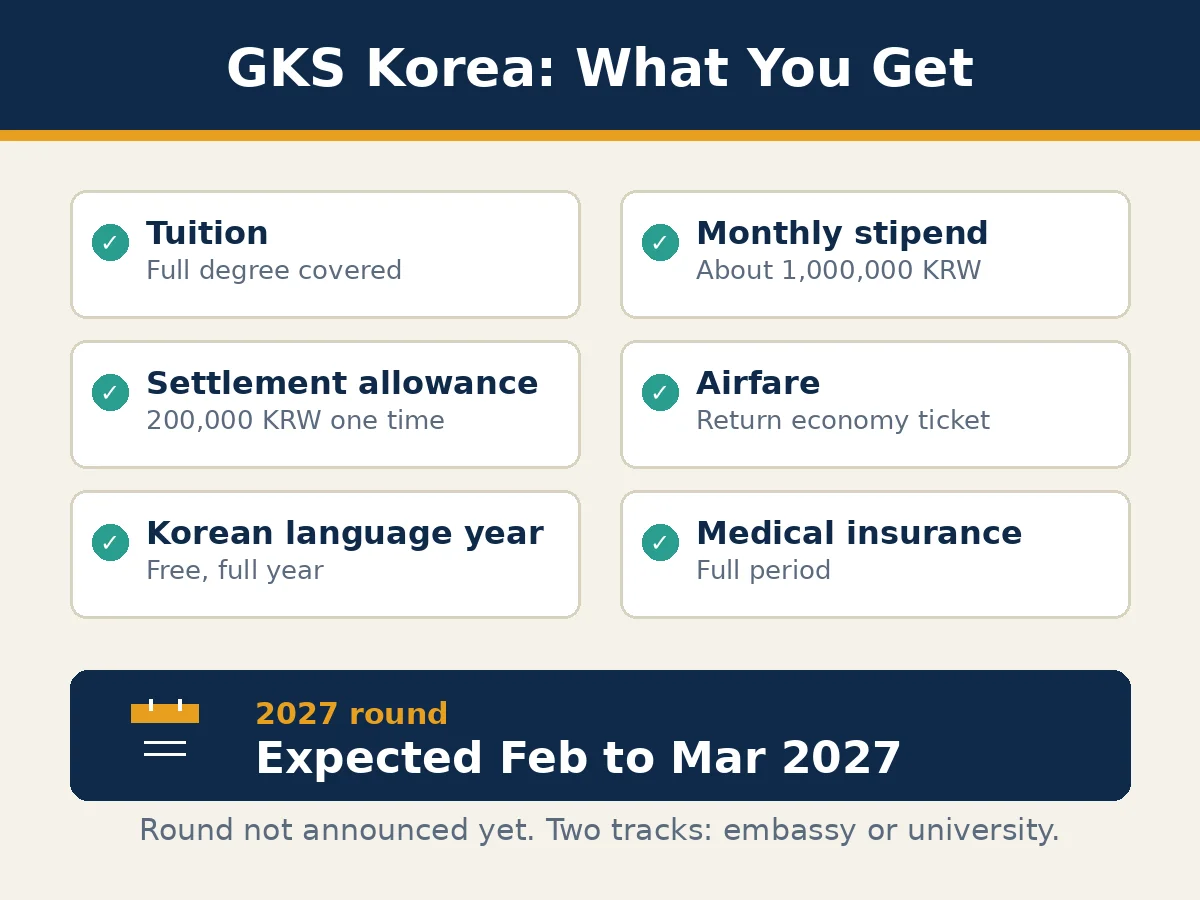
| Benefit | What it means in practice |
|---|---|
| Full tuition | Covered for the whole degree, including the language year, up to 5,000,000 KRW per semester |
| Monthly stipend | 1,200,000 KRW per month during the language year, 1,380,000 KRW per month during the degree |
| Settlement allowance | 200,000 KRW paid once on arrival |
| Airfare | Economy return ticket between Pakistan and Korea |
| Language training | One full year of Korean language study, tuition paid |
| Medical insurance | Coverage for the entire scholarship period |
| Research allowance | 210,000 KRW a semester for humanities and social sciences, 240,000 KRW for science and engineering |
| TOPIK bonus | An extra monthly grant if you reach TOPIK level 5 or 6 |
What the scholarship does not cover matters just as much. Your visa application fee, your travel insurance before arrival, and your personal spending money before the first stipend lands are all yours to pay. The first stipend typically takes two to four weeks after arrival, so keep some savings ready for that gap. A student who arrives with no cash at all spends the first month borrowing.
How long it lasts
A masters degree on GKS takes three years in total: one year of Korean language training, then two years of degree study. A PhD takes four years: one year of language training, then three years of research. The language year is not optional padding. You are expected to reach TOPIK level 3 by the end of it, and the year sets up everything that follows, from lectures to daily life to part time work. Students who treat the language year as a holiday arrive at their degree unable to follow a seminar.
The grade bar, translated for Pakistani transcripts
GKS sets one grade bar and offers three ways to clear it. You must meet at least one of these from your most recent degree:
- 80 percent or above in cumulative marks
- Top 20 percent of your class
- The equivalent CGPA cutoff: 2.64 out of 4.0, 2.80 out of 4.3, 2.91 out of 4.5, or 3.23 out of 5.0
Pakistani transcripts cause trouble here because most do not state a class rank or a percentage clearly. If your transcript shows a CGPA but no percentage, get an official letter from your university that states your percentage and your class position, or an official explanation of its grading system. Do not calculate the conversion yourself and print it on plain paper. NIIED trusts documents from the university, not from the applicant.
Final year students can apply with an expected graduation certificate, but the degree must be complete before the programme starts. If your final exams slip past that point, you lose the place.
Three questions everyone asks
Do I need to speak Korean before I apply?
No. The language year exists precisely because most scholars arrive with no Korean. But a TOPIK score earns bonus points, and departments notice it. Even a TOPIK level 2 on your application signals that you are serious about living in Korea rather than just collecting a funded degree.
Is Korea only for engineering and science students?
No. GKS covers humanities, social sciences, business, arts and engineering. The research allowance is lower for humanities and social sciences, 210,000 KRW a semester against 240,000 KRW for science and engineering, but the tuition, stipend and language year are the same for everyone.
What happens if I fail the language year?
You are expected to reach TOPIK level 3 by the end of the language year. Scholars who fall far short can lose their place, so the language year is a real academic requirement, not a gap year. Take it seriously from week one.
Documents Pakistani applicants must prepare
Start early: document preparation is where most Pakistani applications die. Korea is strict about verification, and a single unattested document can end your application at screening.
Tick each item off as you prepare it:
Take the list with you: the checklist above as a printable one page PDF. Download the GKS documents checklist (PDF). Print it, tick each item off, and keep it with your file.
The study plan is the whole game
Most Pakistani GKS applications fail on the study plan, not on grades. Once you clear the bar, the committee scores the study plan and the personal statement.
Winning plans name a specific department, a lab or professor whose work connects to yours, a research question, and a reason Korea is the place to pursue it. Losing plans talk about experiencing Korean culture. The committee reads thousands of those.
Email Korean professors in your field now, not in February. A study plan referencing a professor's actual work is worth more than a grade point of GPA. If you have never written to an academic before, read how to email professors first. A short, specific email that shows you read their recent paper gets answered far more often than a long generic one.
If you are applying from Pakistan
This section is for Pakistani applicants only. The rest of the guide applies to everyone, from any country.
Attestation takes months, so start now. Your degrees and transcripts need HEC attestation, then legalization through the Ministry of Foreign Affairs. Both steps have queues, and the embassy track window is only a few weeks long. Students who start attestation in February miss the deadline. Our HEC and IBCC attestation guide covers the process.
Parents citizenship proof. You and both your parents must hold non Korean citizenship, and you must prove it with documents, not just your own passport. Get your parents CNIC copies and any citizenship proof ready early, because families often discover a name spelling mismatch between documents at the worst moment. Check that the names match across every paper you submit.
The Korean embassy is your deadline source. The embassy track deadline for Pakistan is set by the Korean embassy in Islamabad, and it is not the same as the deadline for India or Bangladesh. Follow the embassy notice, not a blog that quotes another country's date.
Life after arrival. There is a Pakistani student community in Korea, the Pakistan Students and Scholars Association Korea, which helps new scholars settle in. Once you arrive, lean on it for housing, banking and the first confusing weeks. Before you arrive, budget for the gap before your first stipend, as the funding section above explains.
Work backwards from February
The 2027 dates are not published, so this is a preparation calendar built on the past cycles, not a deadline list.
| Month | What to do |
|---|---|
| November to December | Start HEC attestation and Ministry of Foreign Affairs legalization. Shortlist universities and professors. |
| December to January | Draft the study plan and personal statement. Request recommendation letters. Take IELTS if you plan to. |
| January | Watch the Study in Korea notice board and the Korean embassy notice for the 2027 guidelines. |
| February | Embassy track applications open. Submit within the embassy window, usually a few weeks. |
| March | University track deadlines fall. Document screening and interviews follow in the coming months. |
| June | Final results typically arrive in early summer, with language training starting in September. |
Korea is one of several Asian fully funded doors. Also look at Turkiye Burslari and the MEXT Scholarship in Japan if your timeline is flexible.
Official links
Frequently asked questions
When do GKS graduate applications open for 2027?
The 2027 graduate guidelines are not released yet. The graduate round has opened every February for years, with embassy track deadlines in late February and university track deadlines in March. Check the Study in Korea GKS notice board from January 2027, because the exact dates for Pakistan come from the Korean embassy in Islamabad, not from any scholarship blog.
Is there an age limit for the GKS graduate program?
Yes. Graduate applicants must be under 40 at the time of entrance. Final year students can apply with an expected graduation certificate, but your degree must be complete before the programme starts.
Do I need TOPIK or IELTS to apply?
Neither is mandatory at the application stage, and the official guidelines say so. But language evidence earns bonus points, and many departments set their own minimums. An applicant with no TOPIK and no IELTS competes at a disadvantage, so take IELTS if you can.
Can I apply through both the embassy track and the university track?
No. Apply to exactly one track. Applying to both tracks gets you disqualified from both. The embassy track lets you nominate up to three universities, while the university track is a single university and a single department.
What grade do I need for GKS?
You must meet one of these bars from your most recent degree: 80 percent or above, top 20 percent of your class, or the equivalent CGPA cutoff, which NIIED gives as 2.64 out of 4.0, 2.80 out of 4.3, 2.91 out of 4.5, or 3.23 out of 5.0. If your transcript shows none of these clearly, get an official grading explanation from your university.
Can I apply if my parents are Pakistani but I was born abroad?
The rule is about citizenship, not birthplace. You and both your parents must hold non Korean citizenship. If any of the three holds Korean citizenship, including dual citizenship, you are not eligible.