Russian Government Scholarship Quota: Free Tuition in Russia for Pakistani Students
The Russian Government quota gives foreign students tuition free places at Russian universities, with a state stipend and a dormitory place possible depending on the university and your grades. Pakistani applicants register on the official Education in Russia portal, choose up to six universities, and submit documents by 15 January 2027. Pakistan is outside the CIS, so the 15 January date applies. All documents must be translated into Russian and notarized.
- Tuition free study at Russian universities, with a small state stipend and a dormitory place possible
- Apply on the official portal by 15 January 2027, choosing up to six universities in order of preference
- Every document must be translated into Russian and notarized, and the translation chain is where most applications fail
Is this the right scholarship for you
Start with the trade, not the brochure. The Russian quota gives you a tuition free degree at a real university in a country that takes foreign students seriously. In return it asks you to learn Russian, live on a small stipend, and handle a pile of paperwork in a language you do not speak yet. If that trade sounds fair, keep reading. If you want a large monthly payment and a campus where everything happens in English, stop here and look at Turkiye Burslari or the Stipendium Hungaricum in Hungary instead.
The reason this page exists is scale. Russia allocates 30,000 quota places a year to foreign students, a level fixed since 2023 by Government Decree No. 2150. That is a very large door. If your grades are decent and your documents are in order, your chances here are far better than at awards that take 80 people from the entire planet. There is no IELTS requirement for the quota itself, and the programme covers bachelor, master and PhD levels, so undergraduates have a real shot here too.
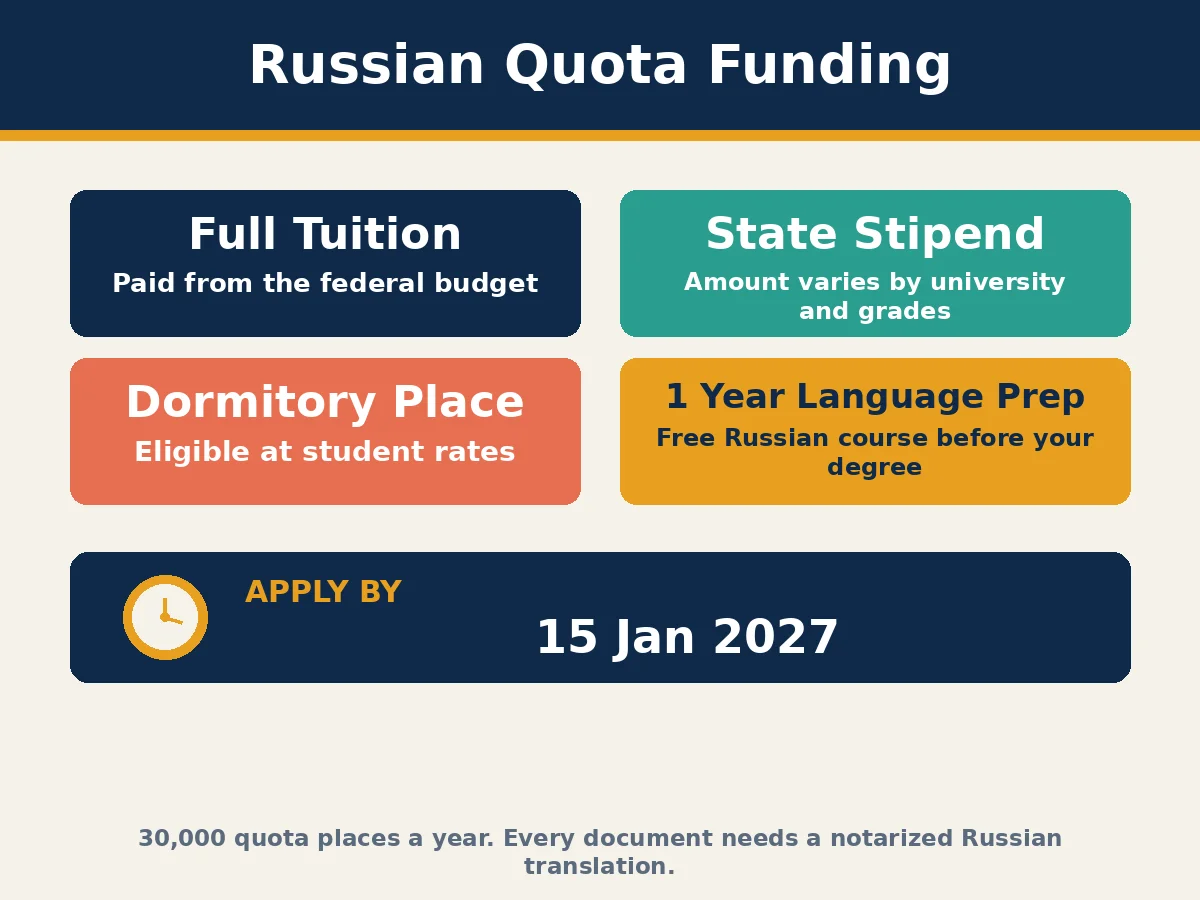
The 2027/28 dates that matter
| Stage | Date |
|---|---|
| Applications open | September 2026 |
| Deadline for CIS countries | 15 December 2026 |
| Deadline for all other countries, including Pakistan | 15 January 2027 |
| Selection | In the months after the deadline, run by Rossotrudnichestvo through Russian Houses and embassies |
| Study starts | September 2027, with a preparatory year first if your programme is taught in Russian |
Pakistan is outside the CIS, so the 15 January 2027 date is the one that applies to you. Deadlines can vary by country and selection channel, so confirm the date with the Russian House or embassy responsible for Pakistan before you plan around it. The deadline is the date your application must read Submitted on the portal, not the date you start filling it in.
Official information checked 13 November 2026. The 15 January 2027 deadline is the published non CIS date, confirmed against NUST MISIS guidance for the 2027/28 quota. No single stipend figure is published by the programme, so this guide quotes none.
What the quota pays for, and what it does not
| Covered | Detail |
|---|---|
| Tuition | Full tuition at the assigned university, paid from the federal budget |
| Monthly stipend | A state academic stipend, with the amount set by your university and your grades |
| Preparatory year | One year of Russian language study, free, if your programme is taught in Russian |
| Dormitory | A place is usually offered at student rates. NUST MISIS publishes RUB 2,500 to RUB 3,769 a month, so treat it as a cost, not a free benefit |
| Not covered | Flights, visa fees, health insurance, food and daily living costs |
Go in with a realistic budget, not with the idea that everything is free. The stipend helps with small costs. It does not cover life in a Russian city. Students who arrive expecting a full living allowance run out of money in the first term, and that is the most common reason a quota place is wasted.
Two ways in: the quota and Open Doors
There are two routes to the same quota, and they are easy to confuse. The main route is the one this guide covers: one application on education-in-russia.com, up to six universities, selection through Rossotrudnichestvo. The second route is the Open Doors olympiad, a competition based path with its own portal, its own timeline, and selection by portfolio and exams. It suits strong students who enjoy competitions.
File the main quota application first. Open Doors is a second chance, not a replacement, and its timeline does not wait for you. If you spend the autumn on Open Doors and miss 15 January, you have lost the bigger door.
Who can apply, and who should skip it
You are eligible if you:
- Are a foreign citizen. Pakistani applicants fall under the general deadline of 15 January 2027.
- Hold or are completing the previous level of education: intermediate for bachelor, bachelor for master, master for PhD
- Can provide a medical certificate and a negative HIV test certificate from an official authority
- Hold a passport valid for at least 18 months from the start of your entry visa
Who should NOT apply:
- Anyone who also holds Russian citizenship without permanent residence abroad. The quota is for foreign citizens.
- Anyone unwilling to learn Russian. Even programmes taught in English are few and extremely competitive, so plan on the language.
- Anyone who cannot get documents translated into Russian and notarized. This step is mandatory and it costs money and time.
- Anyone expecting a Western style campus experience and a big stipend. Adjust expectations or pick a different country.
The paperwork chain is the real application
Here is the practical truth about this scholarship. The portal part is easy. The killer is the paperwork chain: attestation, then translation, then notarization, then submission, all before 15 January. Every December students discover that their translator needs two weeks, the notary needs the original, and the original is still sitting in the attestation queue.
So work backwards from the deadline. Aim to have attestation done by early December and translations done by 20 December. That means starting attestation in October, right now. The students who win the Russian quota are rarely the smartest applicants. They are the ones whose files were complete, translated, stamped and submitted while everyone else was still waiting for one signature.
One detail that trips people up: your name must be spelled exactly the same way on every document, including the passport, the certificates, the translations and the portal form. A single letter different between your matric certificate and your passport can stall your file for weeks. Check the spelling before you pay for a single translation.
If you are applying from Pakistan
This section is for Pakistani applicants only. The rest of the guide applies to everyone, from any country.
- Attestation first. Get HEC attestation for degrees and IBCC attestation for board certificates before translation. The translator works from the attested document, so attestation comes first in the chain.
- Translation in Pakistan. Use a certified translator who works into Russian, then get the translation notarized as the portal requires. Ask the translator how long the job takes before you commit, and get it in writing.
- Medical papers. The medical certificate and the HIV negative certificate must come from an official authority. Get them early, because some certificates are only valid for a short time and a stale certificate means a repeat visit.
- Selection in Pakistan. The first selection stage is coordinated through the Russian House or embassy network in your country of residence. Watch for their announcements after you submit, and answer their messages fast.
- Money. Cards issued outside Russia, including Visa and Mastercard, do not work inside Russia. Plan how you will carry money for your first weeks and how you will open a Russian bank account on arrival. Do not land with no way to pay for a taxi from the airport.
- Winter is real. Russian winters are serious, especially outside Moscow and St Petersburg. Budget for proper winter clothing and buy it before you travel, because you will need it from the first week.
Documents checklist
Tick each item off as you prepare it:
Download: Russian Quota Documents Checklist (PDF)
The full checklist above as a printable one page PDF. Print it and tick each item off as you prepare it.
How to apply, step by step
- Register on the official portal and open the My Applications section.
- Select your level of education and field of study, then list up to six universities in order of preference. Put the university you want most first.
- Upload your passport, education documents, achievements and other files.
- Get every foreign language document translated into Russian and notarized. Start this in November at the latest.
- Print the application form from the portal, sign it by hand, scan it and upload it.
- Submit the application by 15 January 2027. Check that the status reads Submitted, not Draft. A draft is not an application.
- Track your status on the portal and follow the instructions for the second stage, including visa paperwork.
What happens after you submit
Selection runs in stages, and patience is part of it. The first selection happens in your country, run by Rossotrudnichestvo through the Russian House or embassy network. If you pass that stage, your file goes to the universities you listed, and the ministry places you at one of them. There is no single results day to circle on a calendar, so check the portal regularly instead of waiting for an email that may never come.
Once you are placed, your visa invitation number appears in your account on the portal. That number is what you take to the Russian embassy or consulate to apply for your student visa. Bring your original documents with you when you travel, including the medical certificates, because the university will ask to see them on arrival. If your programme is taught in Russian, you start with the preparatory year in September 2027 and join the first year of your degree the year after.
Mistakes that cost Pakistani applicants the quota
- Starting attestation in December. The chain takes weeks. October is the time to start, not December.
- Leaving the application in Draft. The portal must show Submitted by 15 January. Open the portal on 14 January and check the status with your own eyes.
- Listing only famous Moscow universities. Six choices is a lot of room. Include strong regional universities where your grades stand out, or you waste the advantage of the quota.
- One name spelled two ways. Match the spelling on your passport exactly, on every document and on the portal form.
- Treating Open Doors as the main route. File the quota application first. Open Doors is the backup.
Official links
Frequently asked questions
Is the Russian quota fully funded?
Tuition is free under the quota and a state academic stipend is paid, but the stipend is small and the amount is set by your university and your grades, so no single figure is published. You pay for flights, visa fees, health insurance, food and usually a dormitory fee, so budget for living costs yourself.
Do I need to know Russian before applying?
No. If you are admitted to a programme taught in Russian, you get a free preparatory year to learn the language before your degree starts. Programmes taught in English exist but are few and very competitive, so plan on learning Russian.
Can I choose my university?
Yes. You list up to six universities in order of preference on the portal. Final placement depends on the selection results and on the quota places each university holds.
What is the Open Doors olympiad, and is it the same thing?
No. Open Doors is a separate competition based route to the same quota, run on od.globaluni.ru with its own timeline and portfolio based selection. File the main quota application first and treat Open Doors as a second chance, not a replacement.
Can I work while I study in Russia?
Full time foreign students may work part time in Russia without a separate work permit. Do not plan your budget around work, because study comes first and part time work in a new language is hard to find.