HEC Overseas Scholarship for PhD: The Faculty Route to a Foreign Doctorate
The HEC Overseas Scholarship is the Higher Education Commission flagship program that sends Pakistani scholars abroad for MS leading to PhD and direct PhD study at Top 200 QS or THE ranked universities, fully funded with tuition, stipend, airfare and insurance. Selection runs through the HEC Aptitude Test and merit ranking. Batch IV closed on 28 August 2026, the test was held on 19 September 2026 and results are announced. No new batch has been announced, so this guide prepares you for the next window.
- Batch IV closed 28 August 2026. The HAT was held 19 September 2026 and results are announced. No new batch announced yet.
- Fully funded MS to PhD and PhD abroad at Top 200 QS or THE universities, in eight thematic areas only.
- Selection is test based. Your HEC Aptitude Test score is the main ranking factor, it stays valid for two years, and your best score counts.
Batch IV is finished. Here is what happened
The last round was Batch IV of Phase III, the Overseas Scholarship for MS and MPhil leading to PhD in Selected Fields. Online registration opened on 9 August 2026 and closed on 28 August 2026 at 4 pm Pakistan time. The HEC Aptitude Test was first listed for 27 September, then rescheduled to 19 September 2026, and the result for the test held on Saturday 19 September is now announced on the HEC Phase III page. No new batch has been announced.
That matters for two reasons. First, if you are reading older guides that give a different test date, they are out of date, and this page corrects the record: the test was 19 September, not 13 September and not 27 September. Second, the gap between rounds is your preparation time. These programs run in batches, not on a fixed calendar, and the winners of the next batch will be those who spent the waiting time preparing, not those who start when the advertisement appears.
Official information checked 12 November 2026. Batch IV closed 28 August 2026 and the HAT was held 19 September 2026, with results announced on the HEC Phase III page. No later batch is announced.
Two tracks, side by side
HEC offers two routes under the same program, and they have different rules. Read the row that matches your own education before you read anything else.
| MS or MPhil leading to PhD | Direct PhD | |
|---|---|---|
| Education needed | BS, BE, masters or equivalent to 16 years of education in a relevant field | Minimum 18 years of education, MS, MPhil, ME or equivalent. Candidates with a 17 year MSc or MS degree from abroad are also eligible, subject to equivalence from the HEC attestation and accreditation division at the time of application |
| Grades needed | Minimum CGPA 3.0 out of 4.0 in the semester system, or first division in the annual system, in your BS, BE, masters or equivalent | Minimum CGPA 3.0 out of 4.0, or first division, in your MS, MPhil or equivalent degree |
| Second divisions | At most one second division throughout your academic career before your final degree | At most one second division throughout your academic career before your final degree |
| Maximum age | 35 years for public sector employees, 30 years for everyone else | 40 years for public sector employees, 35 years for everyone else |
| Age relaxation | None in any case | HEC publishes the same limits with no relaxation stated |
| Where you study | Top 200 QS or THE ranked universities abroad | Top 200 QS or THE ranked universities abroad |
One rule applies to both tracks and catches people out: if you previously availed an HEC funded MS or MPhil scholarship, you can apply for a PhD only after completing a minimum residency period of two years in Pakistan following your MS or MPhil degree, and you must submit a No Objection Certificate from the relevant authority. Employees of any public sector university, college, research and development organisation or government body must submit an NOC from their organisation to apply at all.
The eight thematic areas, and what fits where
Scholarships are available only in the eight priority areas below. Your field must fit one of them, and your research proposal must speak its language. If your field is computer science and the phase emphasises digital transformation, frame your proposal in those terms. The committee judges fit with national priorities, not just intellect.
- Digital Transformation and Emerging Technologies. Artificial intelligence, data science, cyber security, software and related fields that change how Pakistan works.
- Energy, Climate Change and Environment. Power systems, renewables, climate adaptation, water and environmental engineering.
- Agriculture, Food Security and Agri-Tech. Crop science, livestock, irrigation, food systems and farm technology.
- Health, Biotechnology and Life Sciences. Public health, medicine, biotechnology, genetics and related research.
- Engineering and Advanced Manufacturing. Mechanical, electrical, civil, materials and manufacturing research.
- Natural and Physical Sciences. Physics, chemistry, mathematics, earth sciences and related disciplines.
- Social Sciences, Business and Governance. Economics, public policy, management, education and governance research.
- Interdisciplinary and Strategic Areas. Research that crosses two or more of the areas above, or serves a strategic national need.
Before you write a word of your proposal, check that the field is actually offered in your chosen country and university. HEC warns that candidates must make sure their field of subject is offered in their choice of country or university, otherwise the candidate will not be considered for interview or scholarship. HEC also reserves the right to reallocate your university or country choice.
The HAT, decoded
The HEC Aptitude Test is the decisive step, and applicants spend months on research proposals and days on the test. That ratio is upside down. HEC selects on HAT scores and interview results, subject to the approved provincial quotas of the Government of Pakistan and the slots available in each thematic area. Only shortlisted candidates who have passed the HAT are called for interviews.
The test is conducted by the Education Testing Council under HEC, and it follows the familiar HAT pattern of verbal, quantitative and analytical sections. HEC publishes content weightage for the test on the Phase III page, so read that before you choose what to revise. Past papers exist, and a candidate who scores in the top bracket with an average proposal beats a brilliant proposal with a mediocre score, almost every time.
Three facts about the HAT are worth knowing now, while you have time to use them. First, your score remains valid for two years, and if you have appeared in earlier HAT tests, your best score is considered, as long as it is valid on the closing date of application. Second, candidates holding confirmed unconditional admission in a thematic area for the upcoming semester at a Top 200 QS or THE ranked university were exempted from the scholarship test and interview in Batch IV, subject to meeting the eligibility requirements. Third, the test date can move. Batch IV listed 27 September, then moved to 19 September. Watch the HEC page itself in the final weeks, not a blog.
What the money covers, and the fine print
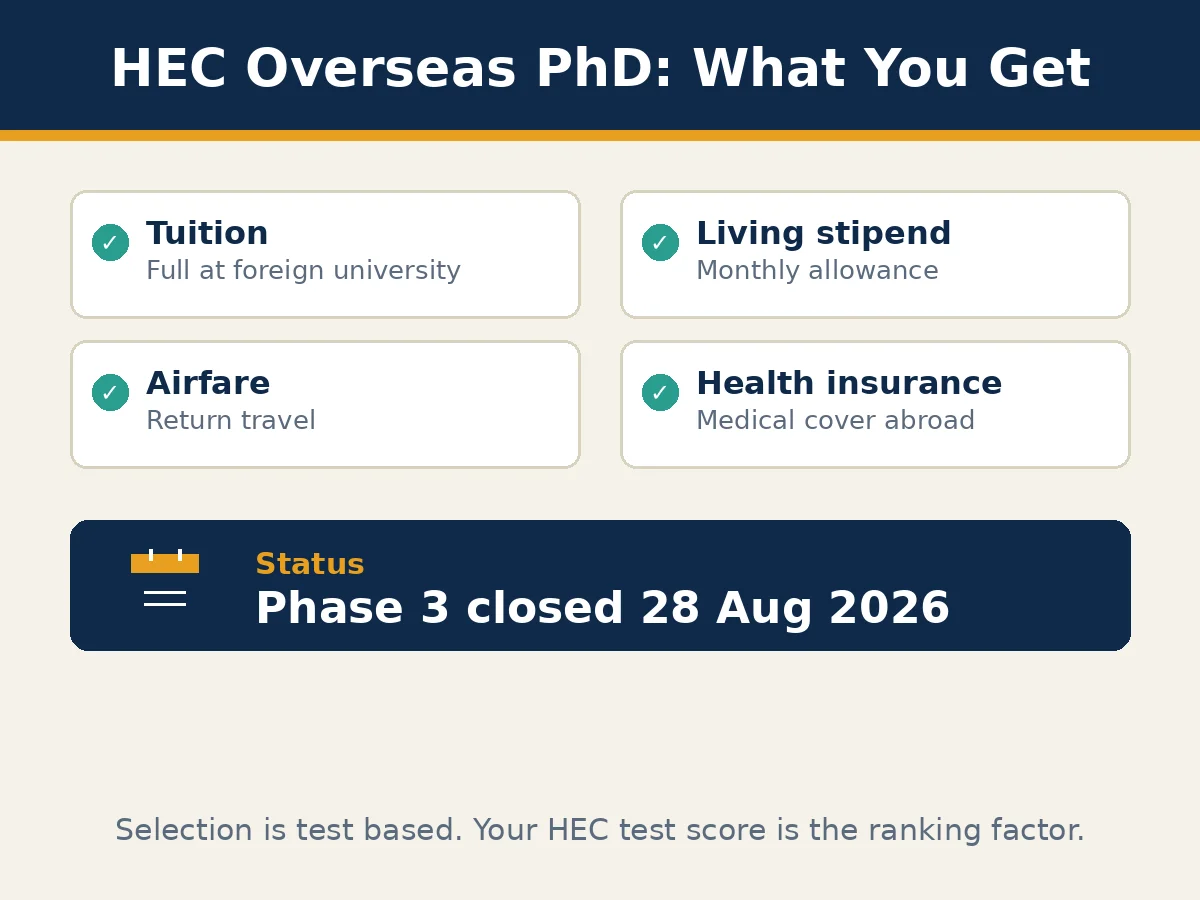
| Benefit | Details |
|---|---|
| Tuition | Full tuition at the foreign university, within the project's approved financial provisions |
| Living stipend | Monthly allowance for the study period, paid under the project provisions |
| Airfare | Return travel to the country of study |
| Health insurance | Medical coverage abroad |
HEC does not publish a single stipend figure for this program, because the provisions are set per project and per country. Do not trust a blog that quotes an exact monthly amount. The fine print matters more than the headline. If the tuition fee exceeds the amount allocated under the project, the candidate is responsible for securing a fee waiver to cover the additional costs.
There is also an application processing fee of Rs 3,000, deposited through 1LINK payment services. Keep the payment proof with your file. And know what you sign. The HEC page publishes templates for the acceptance and declaration, the deed of agreement and surety bond, and the undertaking on details of service and assets. Read them before you apply, not after selection, because they set out the return and service expectations.
Prepare now: the documents file
Start with the slowest papers first. HEC attestation cannot be rushed later, and it is the document that most often delays a scholar.
- HEC attested degrees and transcripts from matric onward. Start HEC attestation now. It is slow and you cannot rush it later. Our HEC and IBCC attestation guide covers the process.
- IBCC equivalence for O and A level qualifications. If you studied under the British system, get this moving early too.
- CNIC, domicile and valid passport. Check that your name matches across all three, and that your passport will stay valid through the placement process.
- Research proposal aligned with a thematic area. One page of real argument beats ten pages of generalities. Name the problem, the method and the national need it serves.
- CV with publications and research experience. Lead with research, not with jobs. List papers, conferences and lab work first.
- NOC from your employer if you serve in a university or government department. Start the conversation with your administration now, not after selection. Scholars have lost months to delayed no objection certificates.
- Proof of your HAT score, if you already hold a valid one. Remember it stays valid for two years and your best score counts.
- Admission offer or supervisor acceptance, if you have one. This strengthens your position enormously and can exempt you from the test and interview.
Documents checklist (PDF)
The eight items above as a printable one page checklist, with the attestation and NOC warnings included. Print it and tick each item off as you prepare it.
If you are applying from Pakistan
This section is for Pakistani applicants only. The rest of the guide applies to anyone the program covers, but these points come from how the process works in Pakistan.
Attestation first, everything else second. HEC attestation of degrees and transcripts from matric onward is the longest queue in the whole process, and IBCC equivalence for O and A levels takes time too. File both while the next batch is still unannounced. A scholar with a perfect HAT score and unattested degrees still waits.
The NOC is a negotiation, not a form. If you serve in a public university or government department, talk to your administration now about a No Objection Certificate. Explain the two year return and service expectations honestly, and get the process moving in writing. The scholars who lose months are the ones who mention the NOC for the first time after selection.
Mind the provincial quotas. Selection is subject to the approved provincial quotas of the Government of Pakistan, so your domicile matters to your ranking pool. Keep your domicile certificate current and consistent with your CNIC.
Take the English and GRE tests before the interview stage. HEC advises candidates to appear in international GRE, TOEFL and IELTS tests before interview and admission, because host universities may require them. Our IELTS vs TOEFL vs Duolingo guide compares the tests, and our guide to emailing professors helps if you are seeking a supervisor.
Keep your HAT score alive. If you already hold a valid HAT score, check its expiry against the likely closing date of the next batch. A score earned this year stays valid for two years, so a test taken now is not wasted if the next batch opens late.
Mistakes that cost a place
- Treating the test as an afterthought. HEC ranks on test scores. A brilliant proposal with a mediocre score loses to a top bracket score with an average proposal, almost every time.
- Proposing a field outside the eight thematic areas. If your subject does not fit a priority area, or the university you chose does not offer it, you are not considered for interview.
- Listing a university whose fee exceeds the allocation. If tuition runs above the project provision, you must secure a fee waiver yourself. Check fees before you choose.
- Leaving the NOC until after selection. Scholars have lost months to delayed no objection certificates. Start the conversation now.
- Sending a printed application too early. HEC asks applicants not to submit a hard copy at the application stage. Only shortlisted applicants submit the signed printout.
The HEC PhD route is one of several doctoral doors. If you want an American PhD, read the HEC US Pakistan Knowledge Corridor and Fulbright Pakistan. For a Canadian research PhD, the Canada Graduate Research Scholarship is the equivalent.
Official links
Frequently asked questions
When was the HEC Aptitude Test held for Batch IV?
On Saturday 19 September 2026. HEC first listed 27 September, then rescheduled the test to 19 September and issued roll number slips, and the result for the test held on 19 September is now announced on the HEC Phase III page. Some older pages still show 27 September or other dates, so trust the HEC page, not a blog.
What are the age limits?
For PhD, the maximum age is 40 years for employees of public sector universities, colleges, research and development organisations and government bodies, and 35 years for everyone else. For MS, it is 35 years for public sector employees and 30 years for everyone else. HEC states there is no age relaxation in any case.
Do I need a foreign university admission before applying?
Not necessarily at application stage, but holding one changes your path. Candidates with confirmed unconditional admission for Fall 2026 in a thematic area at a Top 200 QS or THE ranked university were exempted from the scholarship test and interview, subject to meeting the eligibility rules. Everyone else is ranked on the HAT and interview, and HEC places successful scholars.
How long is my HAT score valid?
Two years. HEC says the HAT score remains valid for two years, and if you have appeared in more than one HAT organised by the Education Testing Council, your best score is considered, as long as it is valid on the closing date of application.
I already used an HEC scholarship for my MS. Can I apply for a PhD now?
Yes, with two conditions. You must have completed a minimum residency period of two years in Pakistan after finishing your MS or MPhil degree, and you must submit a No Objection Certificate from the relevant authority.
Does HEC pay the full tuition fee, whatever the university charges?
Not automatically. Payments follow the project's approved financial provisions, which cover stipends, tuition fees and health insurance. If the tuition fee exceeds the amount allocated under the project, the candidate is responsible for securing a fee waiver to cover the extra amount. Check the fee before you lock in a university choice.