Eiffel Excellence Scholarship France: The Deadline That Is Not Yours
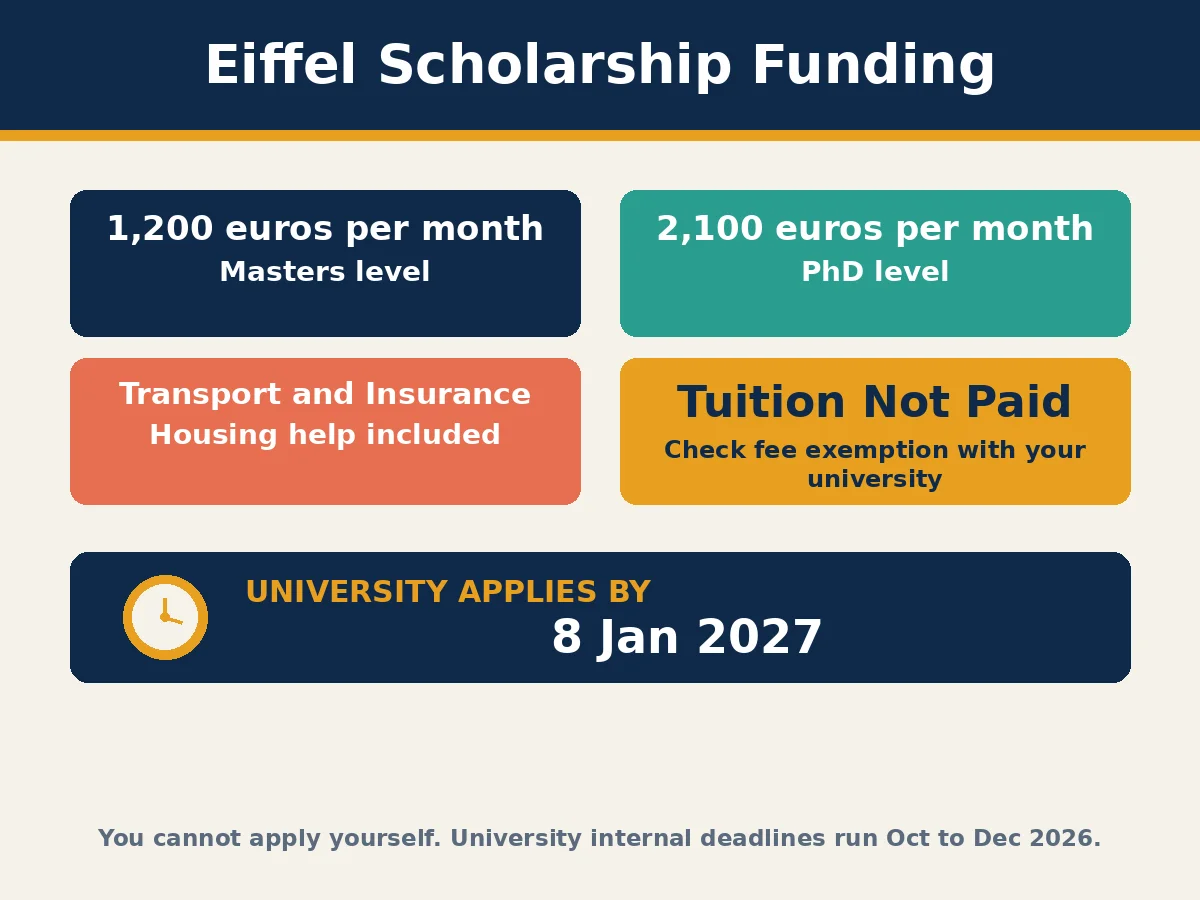
The Eiffel Excellence Scholarship gives international students a monthly allowance of 1,200 euro at Masters level and 2,000 euro at PhD level to study in France. You cannot apply directly. A French university must choose to nominate you, and universities set their own internal deadlines in October and November 2026, well before the Campus France closing date of 6 January 2027. Results are published from 12 April 2027, and studies must begin between 1 September and 30 November 2027.
- 1,200 euro a month for Masters, 2,000 euro a month for PhD, plus travel and insurance help. Tuition is not paid by the programme
- Only a French university can submit your file, so your real deadline is the university internal date in October or November 2026
- Age limit is 29 for Masters and 35 for PhD, and only seven priority fields qualify
The two clocks nobody explains
Almost every Eiffel guide online prints one deadline. For the 2027 call that date is 6 January 2027, and it is real, but it belongs to the university, not to you. Campus France accepts files only from French institutions. Your clock is the internal deadline of the university you are applying to, and those fall between October and December 2026. Some universities closed their PhD nomination windows as early as late October. If you start preparing in December, the game is already over.
So reframe the whole thing in your head. You are not applying for a scholarship. You are applying for admission to a French university, and then asking its international office a simple question: do you nominate students for the Eiffel programme, and what do I need to send you and by when.
Official information checked 13 November 2026. The Campus France deadline of 6 January 2027 and the allowance rates below are from the official Eiffel page and the official 2027 programme rules. University internal dates are examples from university pages for the 2027 call, so confirm each one on the university's own page.
The money, in plain numbers
| Level | Monthly allowance | Longest funding | Total allowance at the longest length |
|---|---|---|---|
| Masters, second year (M2) | 1,200 euro | 12 months | 14,400 euro |
| Masters, first year (M1) | 1,200 euro | 24 months | 28,800 euro |
| Masters, engineering programme | 1,200 euro | 36 months | 43,200 euro |
| PhD | 2,000 euro | 12, 18 or 36 months | 24,000, 36,000 or 72,000 euro |
On top of the allowance, Campus France pays for international airfare, domestic travel support, insurance, help finding housing, and cultural activities for scholarship holders. Tuition and fees are not paid by the programme at either level, so ask your host institution what fee exemption applies to government scholarship holders before you accept.
Be honest with yourself about the gap. This is a monthly allowance, not a full cost scholarship. In expensive cities like Paris the allowance covers living costs but leaves little spare, and the first month always costs more than the rest, with deposits, a transport pass and winter clothes. Budget the difference before you accept, and do not count on part time work in your first semester while you are still settling in.
The seven fields, and what is left out
Only seven thematic areas qualify. If your field is not on this list, Eiffel is not your scholarship, no matter how strong your grades are.
Technical and exact sciences
- Biology and health
- Ecological transition
- Mathematics and digital technology
- Engineering sciences
Humanities and social sciences
- French history, language and civilisation
- Law and political science
- Economics and management
That list leaves out a lot. There is no Eiffel track for clinical medicine practice, fine arts outside the listed scope, or general business degrees. Economics and management qualifies, but a plain MBA style business degree does not fit the way the jury reads the field. If your programme sits on the edge of a listed field, the university nominating you has to make the case, so ask the programme coordinator directly whether past Eiffel winners came from that exact programme.
How nomination actually works
There is no Eiffel application form for students. The whole process runs through the university, in this order:
- Search the Campus France programme catalogue for Masters or PhD programmes in your priority field, and shortlist two or three where your background genuinely fits.
- Apply for admission directly to those universities through their own portals, and contact the programme head or the international office as soon as you apply.
- Ask one question in writing: do you nominate students for the Eiffel programme, what do I need to send you, and by what date. Get the answer in writing too.
- Send the university everything it asks for well before its internal date. October and November are the danger months.
- The university picks its candidates and submits their files to Campus France by 6 January 2027.
- Results are published from 12 April 2027, and studies must begin between 1 September and 30 November 2027. The start date cannot be postponed.
Here are real internal deadlines from university pages for the 2027 call, to show how early the real clock runs. Confirm each one on the university's own page, because they change every year.
| University | Level | Internal date for the 2027 call |
|---|---|---|
| Paris Cité | Masters | 29 October 2026 |
| Paris Cité | PhD | 2 November 2026 |
| Paris Saclay, PhD joint supervision only | PhD | 6 November 2026 |
| Toulouse | Masters pre application | 15 November 2026 |
| Bordeaux INP | Masters | 20 November 2026 |
| Paris Saclay | Masters | 26 November 2026 |
| Toulouse | PhD pre application | 29 November 2026 |
| Institut Agro Montpellier | Masters and PhD | 9 December 2026 |
Notice the pattern. By the time Campus France closes on 6 January, every one of these windows has already shut. A student who starts in December has already missed Paris Cite, Paris Saclay and Toulouse. That is why the title of this page says the deadline is not yours. Your deadline was in October or November, and it belonged to a university office you had probably never heard of.
Who can apply, and who should skip this one
You are eligible if you:
- Are a non French citizen applying for a Masters or PhD in one of the seven priority fields
- Are 29 or younger for Masters, 35 or younger for PhD, at the time of selection. The 2027 guide turns this into birth dates: born after 31 March 1997 for Masters, and born after 31 March 1991 for PhD. Ask your institution to confirm the exact date that applies to you.
- Have an academic record strong enough that a French university wants to spend one of its limited nomination slots on you
- Are ready to start your studies in France between 1 September and 30 November 2027, with no deferral
Who should NOT apply:
- Anyone whose field is outside the seven priority areas.
- Anyone over the age limits. They are strict, and the jury does not bend them.
- Anyone hoping to apply directly to Campus France. That door does not exist for students.
- Anyone who has not started contacting universities by October. The internal deadlines will pass while you are still drafting your CV.
- Anyone already holding another French government scholarship or an Erasmus Mundus scholarship. Eiffel cannot be combined with those, and you would have to decline one of them.
Documents to prepare
Print this first: Eiffel Documents Checklist (PDF)
One page, tick boxes, everything in the list below. Print it, tick each item off as you prepare it, and keep it with your file.
Tick each item off as you prepare it:
The university, not Campus France, tells you what it wants and in what format. Some universities want the motivation letter in French, some in English, and some want a separate one page project description. Ask before you write, because a letter written for the wrong reader is wasted work.
What winners do differently
Here is the insider logic. A French university gets a limited number of Eiffel nominations each year. It will spend them on candidates who make the university look good: top grades, a clear project, and a real chance of winning. Your job is not to be the most deserving person in Pakistan. Your job is to be the candidate a French professor remembers when the international office asks for names.
That means your admission application is your scholarship application. A strong, specific motivation letter that names the lab, the professor and the courses you want will travel from the admissions file straight into the nomination discussion. A generic letter will not.
One more thing Pakistani applicants get wrong. Do not email ten universities with the same text. Pick three where your background genuinely fits, and write each one like you chose them on purpose. French academics can smell a mass email from the first line, and the Eiffel jury rewards exactly the kind of candidate who does not send them. If you need to contact a lab first, read how to email professors before you write a word.
If you are applying from Pakistan
This section is for Pakistani applicants only. The rest of the guide applies to everyone, from any country.
- Get your documents attested early. French universities ask for certified translations of your degrees and transcripts, and Pakistani degrees need HEC attestation first. Attestation queues in Pakistan are slow, and a translation done from an unattested degree may have to be done again.
- English taught programmes are your main door. Many Masters and PhD programmes in engineering and sciences are taught fully in English, so you do not need French to study. You do need French for daily life, so start learning basic French while your application is running. It also helps in the visa interview.
- Your grades need context. French universities read marks out of 20, and a Pakistani percentage means little without explanation. Ask your university for an official grading scale letter, and put your position in class or your CGPA on the CV where the reader can see it in seconds.
- The visa clock is short. Results come from 12 April 2027 and studies start in September, so winners have about four months for the visa process. Keep your passport valid, your funds ready and your Campus France Pakistan file in mind, because the visa interview is a separate step after the scholarship result.
- Do not pay an agent for a nomination. No consultant can buy you a university nomination. The nomination comes from a professor or an international office that has read your file and wants you. Spend that money on certified translations instead.
France is one of several European fully funded doors. Also consider DAAD EPOS in Germany and the Stipendium Hungaricum in Hungary.
Official links
- Eiffel Excellence Scholarship programme page
- Eiffel programme rules, 2027 session (PDF)
- Campus France programme catalogue
Frequently asked questions
Can I apply to Campus France directly for Eiffel?
No. Only French higher education institutions can submit applications. You apply for admission to a French programme first, and the university decides whether to nominate you. Applications sent by students directly to Campus France are declared ineligible.
Does Eiffel cover tuition fees?
No. The programme pays a monthly allowance plus transport, insurance and housing help, but it does not pay tuition directly. Ask your host institution what fee exemption applies to government scholarship holders, because many French public universities charge very low tuition for international students in the first place.
Why do some websites say the PhD allowance is 2,100 euro?
That was the old rate. The official 2027 rules set the allowance at 2,000 euro a month for PhD students and 1,200 euro a month for Masters students, both effective from 1 January 2026. Any page still printing 2,100 euro is using last year's figure.
Do I need to speak French?
Not necessarily. Many Masters and PhD programmes in France, especially in engineering and sciences, are taught fully in English. Check the language of your specific programme, and remember that daily life in France is much easier with at least basic French.
Can I be nominated by two universities at once?
No. Only one French institution can nominate you in a given session, so pick your strongest fit and commit to it. Spreading the same file across many universities also weakens each application, because the nomination depends on a professor or office that actually wants you.