HEC US Pakistan Knowledge Corridor: Fully Funded PhD in America
The HEC US Pakistan Knowledge Corridor funds Pakistani PhD students at top ranked American universities. If your university ranks in the top 50 of the QS world rankings, HEC pays full tuition plus a yearly stipend of 19,200 dollars, health insurance and return airfare. For universities ranked 51 to 100, tuition support goes up to 12,000 dollars a year with the same stipend. The Spring intake round closed on 30 October 2026. The next deadline is 30 March 2027, for Fall 2027 admission.
- Top 50 QS universities get full tuition, top 51 to 100 get up to 12,000 dollars a year in tuition
- Yearly stipend of 19,200 dollars plus health insurance and 250,000 rupees airfare in both categories
- You must already hold a US admission letter, plus GRE 300 or HAT 60 percent. Next deadline: 30 March 2027 for Fall 2027
Two deadlines, two intakes
The 2027 cycle of the Knowledge Corridor has two intakes, and they have two different deadlines. Mixing them up is the easiest way to miss this scholarship.
| Intake | Deadline | Status |
|---|---|---|
| Spring or Summer 2027 | 30 October 2026 | Closed |
| Fall 2027 | 30 March 2027 | Open, this is the deadline that matters now |
If your US admission is for Fall 2027, 30 March 2027 is your date. If you applied for the Spring or Summer round and were not selected, HEC says you must apply again for the Fall round. An old application does not carry over.
Official information checked 13 November 2026. Category ranges, stipend and both deadlines read directly from the HEC FAQ page. Category II is ranks 51 to 100, not 51 to 300 as some guides still print.
Admission first, funding second
Most HEC scholarships work like this: HEC selects you, then you find a university. The Knowledge Corridor works backwards. You win admission to a top American university first, and then HEC pays for it. Understanding this order changes everything about how you prepare.
If you are spending your time filling HEC forms without a US admission letter, you are doing the steps in the wrong order. The Knowledge Corridor does not rescue a weak application season. It rewards a strong one. The smartest play I have seen from Pakistani students is to treat the American PhD application as the real target and the HEC funding as the bonus. Apply to ten to fifteen US programmes, chase the professors whose research matches yours, and get the admission. Once you hold that letter, the HEC application is mostly paperwork. If you have never contacted an academic before, read how to email professors first.
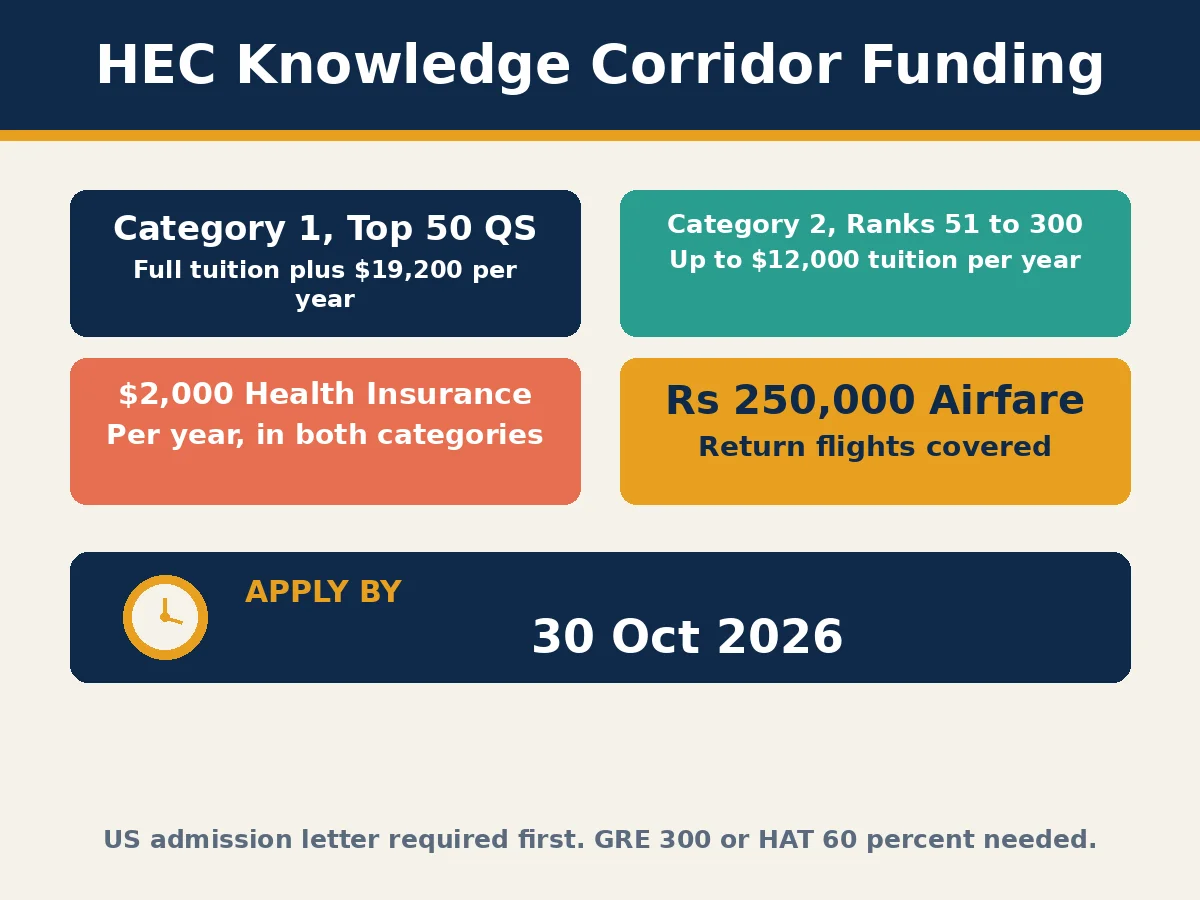
The programme has two categories. Category one is for admissions in the top 50 of the QS world university rankings. Category two covers ranks 51 to 100. Both are for PhD programmes only, not for MS leading to PhD. HEC lists preferred subject fields in its advertisement, so check whether your field is on that list before you apply.
Category I versus Category II
| Category I | Category II | |
|---|---|---|
| University rank | Top 50, QS world rankings | 51 to 100, QS world rankings |
| Tuition | Full tuition cost as per the university invoice | Up to 12,000 dollars a year |
| Yearly stipend | 19,200 dollars | 19,200 dollars |
| Health insurance | 2,000 dollars a year, or the actual cost if lower | 2,000 dollars a year, or the actual cost if lower |
| Return airfare | 250,000 rupees | 250,000 rupees |
A correction worth stating plainly: some guides list Category II as ranks 51 to 300. That range comes from older wording. The current HEC FAQ lists Category II as QS ranks 51 to 100, and the 2027 announcement covers top 100 universities. If your university ranks 150th, do not plan around Category II. Check the current advertisement on the HEC programme page before you rely on any rank band.
The stipend figure has also been printed two ways in the press, 19,200 dollars and 19,000 dollars. The HEC FAQ itself lists 19,200 dollars a year for both categories, and this guide follows the FAQ.
What HEC pays
Category one, for top 50 QS ranked universities:
- Full tuition cost as per the university invoice
- Annual stipend of 19,200 US dollars
- Annual health insurance of 2,000 US dollars, or the actual cost if lower
- Return airfare of 250,000 Pakistani rupees
Category two, for universities ranked 51 to 100:
- Annual tuition cost up to 12,000 US dollars
- Annual stipend of 19,200 US dollars
- Annual health insurance of 2,000 US dollars, or the actual cost if lower
- Return airfare of 250,000 Pakistani rupees
Note the gap in Category II. If your tuition is 40,000 dollars a year and HEC pays 12,000, the rest must come from somewhere, usually a tuition waiver or assistantship from the university itself. Ask your department what it covers before you accept the admission, because HEC will not close that gap for you.
The eligibility gate, in order
Check yourself against these gates in order. Failing any one of them ends the application.
- Admission. You hold an admission letter from an eligible US university, in the right QS band, for a PhD programme. No letter, no application.
- Test score. A valid GRE General score of at least 300 in total, or a HAT score of at least 60 percent. HEC asks for 300, but American departments deciding your admission do not care about HEC minimums. A 300 gets you past the HEC gate and rejected by the department. Aim for 315 plus in practice, with strong quantitative scores for science and engineering fields.
- Degree and marks. At least a four year bachelor degree, meaning 16 years of education, or an MS or MPhil with 18 years. At least 60 percent in your last degree. A maximum of one second division across your whole academic career is allowed.
- Age. 35 or younger on the closing date, or 40 or younger if you are a full time regular government employee, a faculty member of a public sector university or college, or a researcher at an approved research organisation.
- No other award. You are not receiving any other scholarship at the same time, and you do not already hold a PhD degree.
- The bond. You are willing to return and serve in Pakistani universities or research organisations after your PhD. See the section below before you commit.
HEC does not ask for IELTS or TOEFL for this scholarship, and you can apply without either score. Your American university may still ask for one as part of admission, so check the university requirement separately.
Documents checklist
Print this first: HEC Knowledge Corridor Documents Checklist (PDF)
One page, tick boxes, everything in the list below. Print it, tick each item off as you prepare it, and keep it with your file.
Tick each item off as you prepare it:
For the provisional award letter, HEC asks for the admission letter, the GRE or HAT score, attested academic documents, attested CNIC, domicile and passport, and the graduate school contact details at minimum. Get the attestation done early. HEC attestation queues are slow, and a missing stamp in the last week is the most avoidable way to miss 30 March.
How to apply on the HEC portal, step by step
- Apply to American universities first. This is the long step. Target the QS ranking band you can realistically reach and secure your admission letter.
- Take the GRE early. A score of 300 is the minimum, but for top 50 admissions you will want much more. Alternatively, secure a HAT score of 60 percent.
- Get your degrees attested through the HEC online attestation portal. Do not leave this for the last week.
- Register on the HEC scholarship portal, fill your profile completely, and select the Knowledge Corridor programme.
- Upload the admission letter, test scores and all documents. Make sure your application status shows Submitted. Applications left in Saved status are not considered.
- For the Fall 2027 intake, submit by 30 March 2027. If you applied in an earlier round, apply again. Old applications do not carry over.
If you are applying from Pakistan
This section is for Pakistani applicants only. The rest of the guide applies to everyone, from any country.
- Attestation. Get your degrees attested through the HEC online attestation portal. For the provisional award letter, HEC also asks for your CNIC, domicile and passport attested by a gazetted officer, so keep attested copies of those ready too.
- GRE or HAT. The GRE opens doors in America, so take it if you can afford it and your target departments value it. The HAT is the cheaper local option and it satisfies HEC, but it does nothing for your US admission. Choose based on where you are weak: if your admission is the risk, take the GRE.
- The visa. Only the J-1 visa is acceptable for this scholarship. Check the J-1 rules and the two year home country requirement with the US embassy before you plan around a different visa.
- Professors matter more than the portal. American PhD admission runs on supervisors. Email professors whose research matches yours, with a short message and your CV attached. One interested professor is worth more than ten extra portal fields filled perfectly.
- The bond is real. See the next section. Talk to your family about it before you apply, not after you win.
The service bond, read before you sign
HEC funds your PhD on the condition that you come back to Pakistan and serve in a university or research organisation for the period stated in your agreement. You sign a contract to that effect. This is not a suggestion. It is the deal.
Think about it in plain terms. A funded PhD in America is worth far more than the money HEC pays. The bond is how Pakistan gets its share of that value back. If you plan to settle abroad after your PhD, this scholarship is not for you, and signing a contract you plan to break will follow you. If you do plan to teach or research in Pakistan, the bond is not a burden. It is a job waiting for you at home, in a system that needs PhDs badly.
Compare with other United States PhD routes
The Knowledge Corridor is one of several American PhD doors. Also read Fulbright Pakistan, which funds the degree itself and suits applicants who do not yet hold admission. If you are open to other countries, the HEC Overseas PhD Scholarship covers more destinations.
Official links
- HEC US Pakistan Knowledge Corridor FAQ
- HEC Knowledge Corridor programme page
- HEC scholarship portal
- HEC online attestation portal
Frequently asked questions
Can I apply without a US admission letter?
No. You must have secured admission to an eligible US university before you apply. The scholarship funds your PhD, it does not get you admitted.
What test score do I need?
A valid GRE General score of at least 300 in total, or a HAT score of at least 60 percent. One of the two is required. HEC does not ask for IELTS or TOEFL, but your American university may still ask for one.
Which universities count for Category II?
Universities ranked 51 to 100 in the QS world rankings. The current HEC FAQ lists Category II as ranks 51 to 100. Some guides still print 51 to 300 from older wording, but the current call uses 51 to 100, so check your university rank against that band.
Is there a Fall 2027 round as well?
Yes. The 30 October 2026 deadline covered a Spring or Summer 2027 start. The Fall 2027 round closes on 30 March 2027. If you applied in an earlier round, HEC says you must apply again.
What is the service bond?
HEC funds your PhD on the condition that you return to Pakistan and serve in a university or research organisation after you finish. You sign a contract to that effect. If you have no intention of working in Pakistan after your PhD, do not sign up for a bond you plan to break.