Swiss Government Excellence Scholarship 2027: CHF 2,450 a Month for Pakistani Researchers
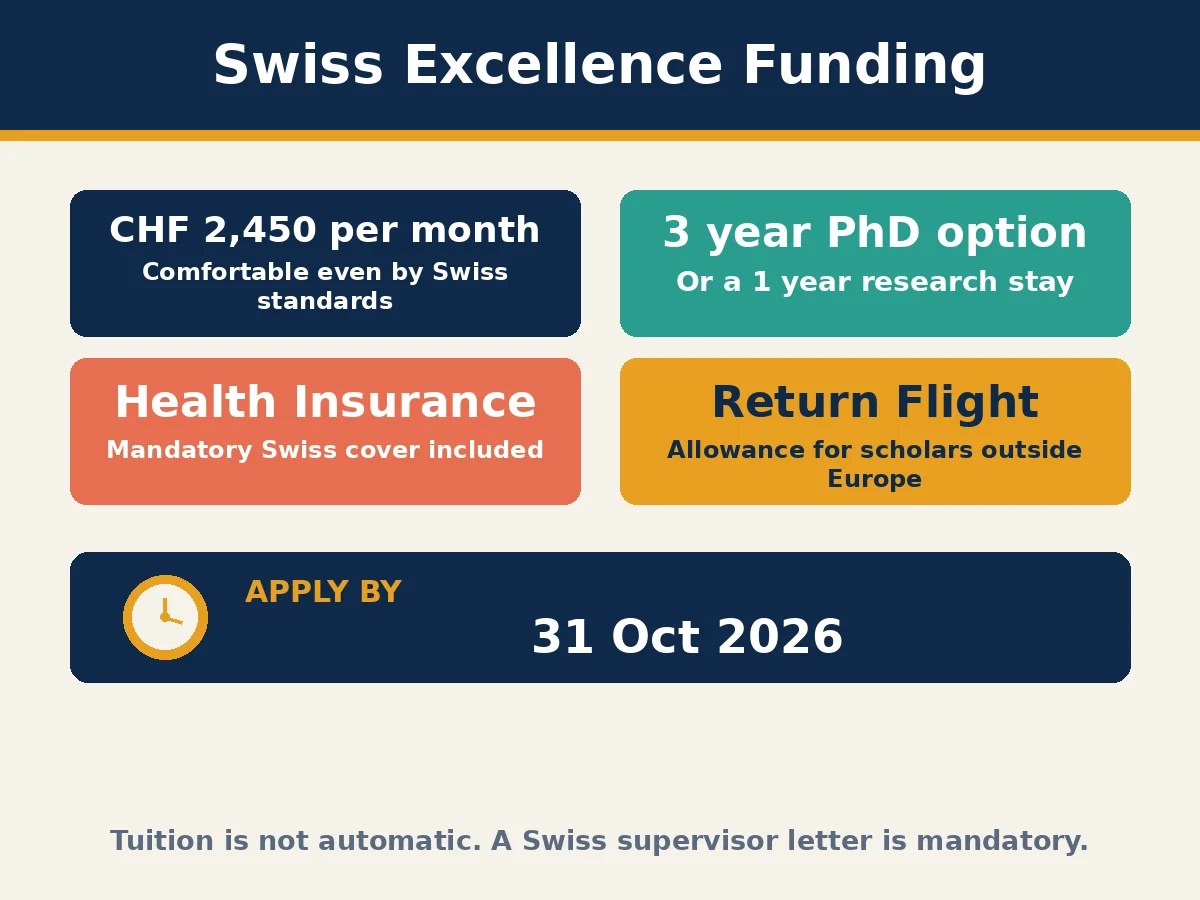
The Swiss Government Excellence Scholarship funds a three year PhD or a one year research stay in Switzerland for Pakistani researchers, paying CHF 2,450 a month plus health insurance and a return flight allowance. You must hold a Masters degree, be born after 31 December 1991, and have a support letter from a Swiss supervisor. The 2027 to 2028 round for Pakistan closed on 31 October 2026, and the next round will be advertised from August 2027.
- CHF 2,450 a month plus health insurance, a flight allowance, a CHF 600 housing deposit grant and a half fare travel card, for a 3 year PhD or 1 year research stay
- A letter from a Swiss supervisor is mandatory, so start emailing professors now for the next round
- The 2027 to 2028 deadline for Pakistan was 31 October 2026 and is closed. The 2028 to 2029 round will be advertised from August 2027. HEC only advertises the award, it does not select candidates
Start with the supervisor, not the scholarship
Most scholarship guides start with the money. This one starts with the person, because the person decides everything here.
The Swiss Government Excellence Scholarship is not an award you win by filling in a good form. It is an award you win by finding a Swiss professor who wants your research in their lab and says so in writing. Without that support letter, your application is not even reviewed. With a strong one, from a professor who helped shape your proposal, you are already ahead of most applicants.
So the honest first step is not the portal. It is your inbox. Read the section on winning a supervisor below before you touch any form, and start those emails months before the next round opens.
Official information checked 13 November 2026. The 2027 to 2028 round is closed for Pakistan, so this guide is built for the next round, advertised from August 2027.
The two tracks Pakistan can use
| Track | Length | Who it fits |
|---|---|---|
| PhD scholarship | Up to 3 years | You hold a Masters and want a full doctorate in Switzerland |
| Research fellowship | 1 year | You are a doctoral candidate who wants a research stay in Switzerland as part of your PhD |
Both tracks pay the same monthly amount and carry the same supervisor rule. The postdoctoral track was discontinued from the 2027 to 2028 cycle onward, so if you already hold a PhD, the research fellowship is the track to look at, subject to the age rule.
The scholarship starts on 1 September 2027 for the current cycle. Decisions are announced by the end of May 2027 at the latest.
What CHF 2,450 buys, and what it does not
| What you get | Details |
|---|---|
| Monthly amount | CHF 2,450 a month for one person's living costs. The scholarship is not a salary |
| Health insurance | The commission covers compulsory health insurance premiums for holders from outside the EU and EFTA, which includes Pakistan |
| Housing | One time grant of CHF 600 for the rental deposit |
| Transport | Half fare travel card for public transport |
| Flight | Return flight allowance for holders from outside the EU and EFTA, amount set by country of origin |
| Extras | The coordinating body organises excursions and activities for scholarship holders |
And the gaps, stated plainly, because they catch people out:
- Tuition and semester fees are not covered. Some institutions charge about CHF 600 to CHF 2,000 per semester, and PhD fees are not always waived. Confirm this with your host university yourself.
- No conference or fieldwork funding. The costs of international conferences are yours, and field research is capped at six months for PhD holders, without extra funding.
- No family allowance. The amount covers one person only. Residence permits for accompanying family are decided by the migration authorities under a restrictive policy, and neither the commission nor the university helps with that.
- No extra money from other work. You must tell the commission about any other funding, and the scholarship may not be used to top up full time employment.
CHF 2,450 a month is a comfortable amount even by Swiss standards, and with health insurance and the flight covered, the deal is generous. Just do not budget as if the fees are paid too.
The timeline: the 2027 to 2028 round is closed
| Stage | Date |
|---|---|
| Call opened | 20 August 2026 |
| Deadline for Pakistan | 31 October 2026, 11:59 pm Swiss time. Closed |
| Decisions announced | By the end of May 2027 |
| Scholarship starts | 1 September 2027 |
| Next round advertised | From August 2027, for the 2028 to 2029 academic year |
Deadlines are set country by country, so a date copied from another country's announcement may not apply to you. Pakistan closed on 31 October 2026. Always check the official country list for Pakistan specifically.
Your runway for the next round looks like this: use the months before August 2027 to find a supervisor and shape the proposal together, so that when the call opens you are submitting, not starting.
How to win a supervisor
This is the heart of the application, so give it the time it deserves.
Write to fewer professors, but write better emails. Read their recent papers. Mention one of them by name. Explain in three sentences why your project fits their lab and what you bring to it. Pakistani students often send long emails full of life story. Swiss professors prefer short emails full of research substance. Give them that, follow up once politely, and move on if there is silence.
Send a real research idea, not a request for a letter. A professor who barely knows your project writes a generic letter, and the selection committee reads generic letters as a warning sign. A professor who helped shape your proposal writes a detailed one, and that signals a real research partnership. Ask for a short call to discuss the idea before you ask for the letter.
Start with the lab, not the ranking. A professor at a smaller cantonal university who works exactly on your topic is a better bet than a famous name at ETH Zurich who works on something adjacent. Fit beats fame in this selection, because the committee scores the quality of the research project and the synergy for future cooperation.
Give it months, not weeks. Finding the right supervisor can take weeks or months of emails, calls and revised proposals. This step cannot wait until the call opens in August.
One practical point that follows from all of this: get your HEC attestation done early. It is the slowest document in the whole process, and October is when every scholarship applicant in Pakistan suddenly wants it done at once.
Documents you will need
Tick each item off as you prepare it:
The same checklist as a printable one page PDF, with the key dates and official links on it: Download the Swiss documents checklist (PDF). Print it and keep it with your file while you work through the supervisor search.
Applications go only through GO ESKAS, the official Grants Online system. Do not send your application by email or on paper. Incomplete files are not considered.
Who can apply, and who should skip this one
You are eligible if you:
- Hold a Masters degree, or will complete one by 31 July 2027, or by 30 June for ETH Zurich
- Were born after 31 December 1991
- Have a research project that a Swiss professor is willing to support in writing
- Can show a strong academic record in your field
Who should NOT apply:
- Anyone looking for a taught Masters degree. This award funds research, not coursework.
- Anyone over the age limit. The birth date rule is strict.
- Anyone who cannot find a supervisor. Applications without a Swiss supervisor support letter are not even reviewed, so cold applying with no professor on board is a waste of time.
- Anyone expecting the scholarship to pay tuition automatically. Confirm fee arrangements with your host first.
If you are applying from Pakistan
This section is for Pakistani applicants. The rest of the guide applies to everyone, from any country.
- HEC attestation first: get your Masters degree and transcripts attested by HEC early. European universities ask for attested documents, and attestation queues in Pakistan are slow. Our HEC and IBCC attestation guide covers the process.
- The degree deadline: your Masters must be complete by 31 July 2027, or 30 June if your host is ETH Zurich. If you are in your final semester now, plan your thesis defence around that date, not around the scholarship deadline.
- The age rule: born after 31 December 1991, no exceptions listed. Check your date of birth on your passport and your CNIC match before you invest months in a supervisor search.
- Who to contact: HEC only advertises the award in Pakistan and plays no role in selection. Country specific questions go to the Swiss representation for Pakistan. The official scholarship page carries the contact for your country in its country list.
- Scam warning: the Swiss government warns that anyone asking for money in the name of this scholarship is running a scam. There is no application fee, no consultant needed, and no hidden payment to anyone. Apply only through GO ESKAS.
- Realistic timeline for the next round: now to July 2027, find your supervisor and write the proposal together. August 2027, the call is advertised and the portal opens. October 2027, submit before the Pakistan deadline, which was 31 October in the last round. May 2028, decisions. September 2028, start.
- Common rejection reasons: no supervisor letter, a generic supervisor letter, a proposal that does not fit the lab, missing the country deadline, an incomplete file, and applying for a taught Masters on a research award.
Mistakes that end Swiss applications
- Treating the supervisor letter as one item on a checklist. The selection committee treats it as the application.
- Emailing fifty professors with the same long email. One thoughtful email to the right lab beats fifty generic ones.
- Leaving attestation to October. HEC attestation is the slowest document in the file, and October is the busiest month.
- Copying another country's deadline. Deadlines are set per country. Pakistan closed on 31 October 2026, and other countries closed on different dates.
- Budgeting as if tuition is covered. It is not. Confirm semester fees with your host university before you accept.
- Paying anyone for help with the application. The application is free and runs only through GO ESKAS. Anyone charging you is running a scam.
Switzerland is one of several European research doors. If you want a bigger programme, look at DAAD EPOS in Germany, and for France read about the Eiffel Excellence Scholarship.
Official links
- Swiss Government Excellence Scholarships, official programme page
- At a glance: amounts, benefits and rules
- Official application portal, GO ESKAS
Frequently asked questions
Can I apply for a Masters degree with this scholarship?
No. For Pakistan the available types are a PhD scholarship and a one year research fellowship. You must already hold a Masters degree, or complete one by 31 July 2027, before the scholarship starts in September 2027. The art scholarship is not listed for Pakistan.
What is the age limit?
You must be born after 31 December 1991. The Swiss authorities describe this as a maximum age of 35, and the rule is strict.
Does the scholarship pay my tuition fees?
No. The scholarship does not cover tuition or semester fees. Some Swiss institutions charge semester fees of about CHF 600 to CHF 2,000 per semester, and some do not waive PhD fees. Confirm the fee position with your host university before you accept.
Does HEC select the winners?
No. HEC only advertises the scholarship in Pakistan. Selection is done entirely by the Federal Commission for Scholarships for Foreign Students in Switzerland, and applications go through the Swiss diplomatic representation, not through HEC.
When does the next round open?
Scholarships for the 2028 to 2029 academic year will be advertised online from August 2027, according to the official SBFI page. The 2027 to 2028 round opened on 20 August 2026 and closed for Pakistan on 31 October 2026, so expect a similar August to October window next time.