Canada Graduate Research Scholarship Doctoral: CAD 40,000 a Year for PhD Students
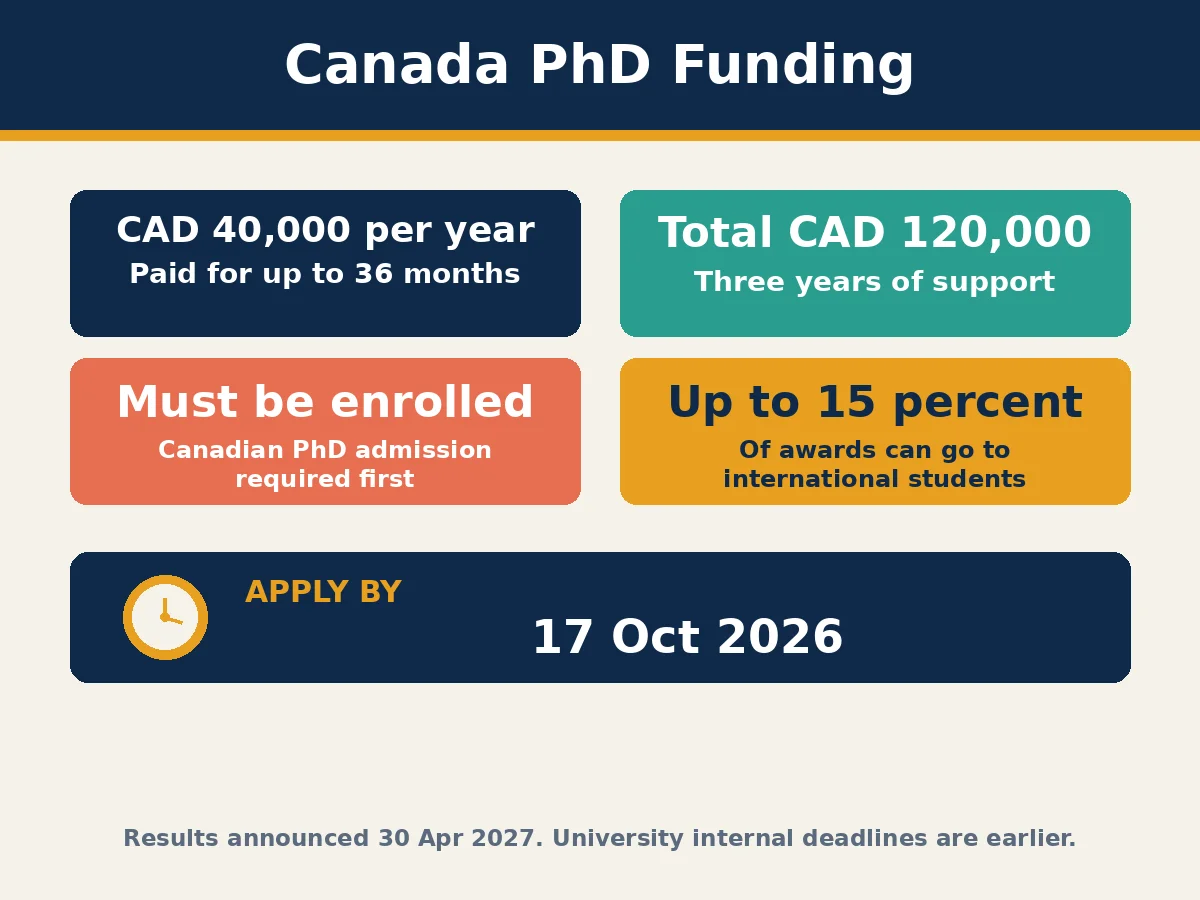
The Canada Graduate Research Scholarship Doctoral programme pays CAD 40,000 a year for up to three years to outstanding PhD students, and up to 15 percent of awards can go to international students. You must already be enrolled in a Canadian doctoral programme by the application deadline, which was 17 October 2026 for direct applicants in the 2026 cycle. The next round dates are not announced yet. The award is part of the Canada Research Training Awards Suite run by CIHR, NSERC and SSHRC together.
- CAD 40,000 a year for 36 months, across health, sciences, engineering, social sciences and humanities
- The 2026 direct deadline was 17 October 2026; the next round dates are not announced yet
- Most applicants apply through their university, whose internal deadline is usually weeks earlier
Read this before you get excited
Every year I watch bright Pakistani students share this scholarship on WhatsApp groups as if it were a ticket to Canada. It is not. It is a reward for people who are already there. Let me explain properly so you do not waste October on an application you cannot win.
The Canada Graduate Research Scholarship Doctoral programme, called CGRS D, is part of the Canada Research Training Awards Suite. Three Canadian federal agencies run it together: CIHR for health research, NSERC for natural sciences and engineering, and SSHRC for social sciences and humanities. It pays CAD 40,000 a year for up to 36 months, which totals CAD 120,000. Results for the 2026 cycle come out by 30 April 2027.
That is the attractive part. Here is the part that filters out almost every reader in Pakistan. International students are eligible, but only up to 15 percent of awards, and only if they are already registered in a Canadian doctoral programme by the application deadline. If you are sitting in Lahore or Karachi with a Masters degree and no Canadian admission, this scholarship is not for you this year. Your path is to win a funded Canadian PhD admission first, and then apply for CGRS D in a later cycle.
Official information checked 13 November 2026. The value, the deadlines and the eligibility rules below are from the official NSERC programme page for the Canada Graduate Research Scholarship Doctoral programme.
Which agency is yours
Picking the wrong agency can end your application, because each agency sends your file to reviewers in its own field. It is your responsibility to select the agency that best suits your research, so choose before you write a word.
| Agency | Field | Examples of what fits |
|---|---|---|
| CIHR | Health research | Medicine, public health, nursing research, health policy, clinical research |
| NSERC | Natural sciences and engineering | Physics, chemistry, computer science, engineering, mathematics, earth sciences |
| SSHRC | Social sciences and humanities | Economics, sociology, history, linguistics, education, law, political science |
If your research sits on a border, read the agency guidance before you decide. NSERC publishes an addendum with examples for health related work, and SSHRC publishes its own subject matter eligibility page. Health research sent to NSERC, or engineering sent to SSHRC, will be judged by the wrong experts. If you are still unsure after reading the guidance, write to the agency contact well before the deadline and ask.
The two routes into the competition
Where you submit depends on where you are registered, not on where you want to hold the award. Get this wrong and your application is rejected without review.
| Your situation on the deadline | Where you apply |
|---|---|
| Registered at a Canadian institution that holds a doctoral award quota for your agency | Through that Canadian institution |
| Registered at a Canadian institution without a quota for your agency | Directly to the agency |
| Not registered anywhere in Canada during the calendar year of application | Directly to the agency |
| Registered at a foreign institution, even if you were at a Canadian institution earlier in the year | Directly to the agency |
A quota is the maximum number of applications an institution can forward to each agency. Institutions receive separate quotas from CIHR, NSERC and SSHRC. Your faculty of graduate studies reviews the applications first, then forwards its picks within the quota. That means you face two selections, not one: your university picks you first, and the agency committee picks you second.
The deadlines differ by route. If you apply through an institution, you must submit by the deadline your institution sets, which may be well in advance of the agency deadline. Some campuses closed in early September, weeks before the agency date. If you apply directly to an agency, you must submit before 8:00 pm Eastern Time on 17 October. In the 2026 cycle that date fell on a Saturday, and the agency rules say that when the deadline falls on a weekend, applications can be submitted on the following business day before 8:00 pm Eastern Time, so direct applicants could submit on Monday 19 October 2026. Late applications are not accepted, and with the exception of personal contact information, you cannot change or update a submitted application after the deadline.
How the award is judged
The committees score every application on two criteria, each worth half the total. Knowing the split tells you where to spend your effort.
| Criterion | Weight | What the committee looks for |
|---|---|---|
| Research potential | 50 percent | Quality of the research proposal, a specific and feasible question, sound method, significance of the contribution, and your potential to carry it out at your stage of study |
| Relevant experience and achievements | 50 percent | Training, scholarships and distinctions, academic record, publications and other contributions, teaching and mentoring, project management, outreach and community work |
A few things in that table surprise first time applicants. Publications count, but so do posters, reports, presentations and community products. Teaching, mentoring and organising a conference count. The committee also looks at how clearly you communicate theoretical, technical and scientific concepts in writing. A brilliant idea buried in confused prose scores badly, because half your mark is about whether you can explain your work.
Extra awards exist inside the same competition. In Budget 2024 the government funded more awards, with extra offers for meritorious applications in priority research areas: advanced digital technologies including AI, quantum and cybersecurity; health including biotechnology; clean technology and resource value chains; environment, climate resilience and the Arctic; food and water security; democratic and community resilience; manufacturing and advanced materials; and defence and dual use technologies. Indigenous student researchers can receive a supplement of 5,000 dollars for one year through the Indigenous Scholars Awards and Supplements Pilot Initiative, and each agency holds up to 10 additional awards for meritorious Black student researchers who self identify and consent to be considered.
What the award pays, and what it does not
- CAD 40,000 a year, paid for up to 36 months, which totals CAD 120,000
- Held at eligible Canadian institutions, with up to 20 percent of awards usable abroad for eligible Canadians only
- Universities often add their own top ups on top of the federal award, so check your campus graduate awards page for stacking rules
- The award supports full time doctoral research and training, including interdisciplinary work
- The agencies may offer supplementary funding through joint initiatives with partners in the not for profit, private and public sectors
What it does not do is pay for your admission, your visa or your move to Canada. Canadian universities decide who gets admitted and funded, and most funded PhD admissions already come with their own support package. Think of CGRS D as a prestige award that replaces or tops up the funding you already hold, not as the funding that gets you into the country.
Who can apply, and who should skip this one
You are eligible if you:
- Have completed no more than 36 months of full time doctoral study by 31 December of the application year. All months of full time study count, including summer months, and the agencies count all studies towards the doctoral degree whether or not they were completed in the same programme or institution
- Are registered in a research oriented doctoral programme that requires a thesis, a major research project or an equivalent merit reviewed output
- Have never received a doctoral level scholarship from CIHR, NSERC or SSHRC before, including a Vanier Canada Graduate Scholarship
- Do not hold a tenure or tenure track appointment at the same time, if your award comes from CIHR or NSERC. SSHRC allows an award while on an approved leave of absence from a tenure track position to undertake a first doctoral degree
- Have applied to no more than one programme in the Canada Research Training Awards Suite this academic year, and have applied to CGRS D no more than three times in total
Who should NOT apply:
- Students who are not yet admitted to a Canadian PhD. This is the single biggest filter and it is non negotiable.
- Anyone who has already held a Vanier or other tri agency doctoral award.
- People past the 36 month mark of doctoral study. The clock starts when you enrolled, not when you feel ready.
- Anyone looking for a way to fund a move to Canada. Canadian universities, not this award, decide who gets admitted and funded.
- Anyone who has already used up three applications to CGRS D. The limit is three, and there is no fourth attempt.
Your documents checklist
Download a printable copy: Canada Graduate Research Scholarship documents checklist (PDF). One page, tick boxes, the same list as below.
Tick each item off as you prepare it:
Two practical notes. All references must use the agency online system and must arrive before the deadline, so ask your referees weeks in advance and confirm they submitted. And if any supporting document is written in a language other than English or French, you must submit a certified translation of it.
If you are applying from Pakistan
This section is for Pakistani applicants only. The rest of the guide applies to everyone, from any country.
- Chase the admission, not the award. Spend your time writing to professors instead of watching the CGRS D deadline. Canadian PhD admissions usually come with their own funding packages, and a strong supervisor who wants you is worth more than any scholarship you apply to cold.
- Your realistic timeline is two years, not two months. Year one: win a funded Canadian PhD admission and arrive in Canada. Year two: do strong research, publish or present something, and apply for CGRS D with your supervisor backing you. The students who win are the ones who arrived on a funded admission, did strong research in year one or two, and then applied.
- The 36 month clock starts at enrolment. If you arrive in September 2027, you must have completed no more than 36 months of doctoral study by 31 December of the year you apply, so your realistic application windows are the 2028 and 2029 cycles. Plan backwards from that.
- Your Pakistani documents need care. Canadian universities ask for official transcripts from all universities you attended, and any document not in English or French needs a certified translation. Get your HEC attestation sorted before you apply for admission, because a slow attestation queue is the most common paperwork delay for Pakistani applicants.
- References matter more here than anywhere else. Your referees submit through the agency system themselves, and the committee weighs your experience and achievements at 50 percent. A referee who knows your research and can describe it in detail beats a famous name who barely remembers you. Our guide to recommendation letters covers how to ask.
Mistakes that waste a year
- Applying to the wrong agency. Health research sent to NSERC or engineering sent to SSHRC lands in front of the wrong reviewers. Read the agency guidance first, and ask the agency if you are unsure.
- Applying through the wrong channel. If your university holds a quota for your agency, you must apply through the university. If you apply directly instead, your application is rejected. Check your registration status and your institution quota before you start.
- Leaving the university deadline until last. The agency deadline is 17 October, but your university deadline may be in early September. The students who miss CGRS D usually miss the university date, not the agency date.
- Applying to two programmes in the same year. You can apply to only one programme in the Canada Research Training Awards Suite per academic year. If you apply to more than one, only the first eligible application is retained.
Canada is one of several research PhD doors. If you want a government funded PhD closer to home, look at the HEC Overseas PhD Scholarship, for a research masters route Australia Awards, and for a European research PhD the Swiss Government Excellence Scholarship.
Official links
Frequently asked questions
Can I apply from Pakistan before getting Canadian admission?
No. International applicants must be registered in a doctoral programme at an eligible Canadian institution by the application deadline. This is not an admission scholarship, and it cannot fund your move to Canada. Win a funded Canadian PhD admission first, then apply for this award in a later cycle.
What is the difference between the agency deadline and the university deadline?
17 October 2026 was the direct agency deadline for people applying straight to CIHR, NSERC or SSHRC in the 2026 cycle, before 8:00 pm Eastern Time. If you apply through a Canadian university, your university sets its own earlier deadline, often in September, because the university must review your file and forward it within its quota.
How many times can I apply for this award?
You can apply a maximum of three times to the Canada Graduate Research Scholarship Doctoral programme. You can also apply to only one programme in the Canada Research Training Awards Suite per academic year, so choose between the Masters and Doctoral awards and between the three agencies carefully.
Can I hold this award outside Canada?
Up to 20 percent of awards may be held abroad, but to hold an award outside Canada you must be a Canadian citizen, a permanent resident or a protected person, and you must have completed at least one earlier degree at a Canadian institution. International students hold their awards at a Canadian institution.
What counts most in the selection?
Research potential counts for 50 percent and relevant experience and achievements count for the other 50 percent. The committees judge the quality of your research proposal, your publications and contributions, your academic record, and your ability to communicate your ideas clearly. A strong proposal matters as much as a strong transcript.